



1/3 HP Pond Fountain: What Size Pond Is It Best For?
A 1/3 HP pond fountain is a floating water-feature system powered by a motor rated at one-third horsepower. It is generally intended for smaller to medium-sized ponds where owners want a combination of water circulation, surface aeration, and decorative spray.
Horsepower alone does not determine how a fountain performs. Pump flow rate, nozzle design, water depth, electrical supply, and the fountain’s construction all influence spray height and water movement. For example, published specifications for some 1/3 HP fountain systems show flow rates around 300 gallons per minute, while other designs using the same nominal motor rating can have substantially different flow characteristics.
This distinction is important when comparing fountain systems because a higher horsepower rating does not automatically mean better performance for every pond.
How Does a 1/3 HP Fountain Work?
A floating fountain uses a pump to draw pond water through an intake and push it through a nozzle.
The nozzle directs the water upward or outward, creating the visible fountain pattern. As the water falls back into the pond, it contributes to surface movement and interaction between the water and surrounding air.
Some 1/3 HP systems are designed for continuous operation and use floating platforms that keep the pump assembly at the surface. One published 1/3 HP system, for example, uses a 4000 GPH pump, a floating platform, interchangeable spray nozzles, and a 120V electrical supply.
The exact configuration differs between fountain models, so specifications should always be checked before installation.
How Does Horsepower Affect Fountain Performance?
Horsepower indicates the motor’s ability to provide mechanical power, but it should not be considered a direct measurement of spray height.
Pump performance is affected by the amount of water being moved and the resistance the pump encounters while doing so. Nozzle size and configuration can also change the final spray pattern.
A fountain designed primarily for aeration may prioritize water movement over dramatic height, while a decorative fountain may use a nozzle that produces a taller or wider display.
Consequently, buyers should compare horsepower alongside flow rate, operating depth, spray dimensions, and nozzle specifications.
What Size Pond Is Suitable for a 1/3 HP Fountain?
There is no single pond size that applies to every 1/3 HP fountain.
Different manufacturers and pump configurations provide different recommendations. For example, one 1/3 HP aerating fountain specification lists a suggested pond size of up to approximately one-half acre, while another published fountain guide describes typical 1/3 HP pumps as suitable for smaller ponds of roughly one-quarter acre or less.
This variation demonstrates why pond owners should evaluate the specific fountain rather than relying solely on horsepower.
Pond depth is equally important. Some 1/3 HP systems specify a minimum operating depth of approximately 32 inches.
Why Is Water Circulation Important?
Water circulation helps prevent the surface from remaining completely stagnant.
A fountain continuously moves water through the pump and back into the pond. This can distribute water across a broader area and contribute to mixing.
Circulation is particularly relevant in ponds where temperature, oxygen levels, or water movement vary between different areas.
However, fountain circulation should not be considered a complete pond-management strategy. Water quality also depends on factors such as nutrient levels, biological activity, temperature, pond depth, and organic material.
Can a Fountain Improve Pond Aeration?
Fountains can contribute to aeration because water is exposed to air as it passes through the spray.
The process increases the interaction between the water and atmosphere, although the actual oxygen-transfer performance depends on fountain design and operating conditions.
Aeration is important because dissolved oxygen supports aquatic organisms and influences biological processes within a pond. University of Florida guidance notes that aeration systems can help prevent critically low oxygen conditions, although different aeration methods have different operating characteristics.
For ponds experiencing serious oxygen problems, a fountain should not automatically be assumed to be the most appropriate solution. Pond conditions should be assessed before selecting an aeration system.
What Determines the Fountain Spray Pattern?
The nozzle is one of the most important factors determining appearance.
Different nozzles can produce narrow vertical streams, broad sprays, fan shapes, or other patterns. Changing the nozzle can therefore significantly alter how a fountain looks without necessarily changing the motor.
Flow rate also influences the spray.
For instance, published specifications for one 1/3 HP system indicate a 300 GPM flow rate with an approximately 5-foot-high and 7-to-18-foot-wide spray pattern.
These measurements should be treated as model-specific rather than universal specifications for every 1/3 HP fountain.
What Water Depth Does a Fountain Need?
Adequate water depth is necessary for proper operation.
The pump intake must remain submerged, and the fountain should have enough clearance to operate without drawing excessive sediment or debris from the pond bottom.
Some 1/3 HP fountain systems specify a minimum operating depth of 32 inches.
Pond levels can change because of evaporation, rainfall, seasonal weather, or water-management activities.
Owners should therefore monitor water levels, particularly during extended periods of dry weather.
How Should a Floating Fountain Be Anchored?
Floating fountains can move because of wind and water movement, so anchoring is generally used to keep them positioned correctly.
The anchoring arrangement depends on the fountain design and pond conditions. Some systems use ropes or cables connected to anchors positioned on the pond bottom.
Published specifications for certain 1/3 HP systems recommend two anchors, with the required weight depending on the specific equipment.
Anchoring should be strong enough to keep the fountain positioned while avoiding excessive strain on the floating structure.
What Maintenance Does a Pond Fountain Need?
Regular maintenance can help preserve pump performance and reduce avoidable interruptions.
Typical tasks include:
- Cleaning the intake
- Removing leaves and debris
- Inspecting the nozzle
- Checking electrical connections
- Examining the float
- Inspecting anchor lines
- Monitoring water depth
- Looking for algae or sediment accumulation
Debris is particularly important because organic material can restrict water intake.
A fountain that suddenly produces less water may have a clogged intake or nozzle rather than a failed motor.
How Can You Troubleshoot Low Water Flow?
Reduced water output should be investigated systematically.
Start by checking whether the pond has sufficient water. Next, inspect the intake for leaves, algae, sediment, or other debris.
The nozzle should also be checked because partial blockage can change the spray pattern or reduce its height.
If these areas are clear, additional causes could include mechanical wear, electrical problems, damaged components, or operating conditions outside the fountain’s specifications.
Electrical troubleshooting should be performed by an appropriately qualified person, particularly because the equipment operates around water.
Does Weather Affect Fountain Operation?
Outdoor fountains are exposed to wind, rain, heat, cold, and changing water levels.
Strong wind can alter the direction of the spray and cause water to land outside the intended pond area. This can gradually reduce water levels if substantial amounts of spray are carried away.
Heavy rainfall can have the opposite effect by increasing pond levels.
In freezing climates, owners should follow the equipment manufacturer’s recommendations regarding winter operation. Ice formation can create additional mechanical and structural stresses depending on the fountain design.
Can Pond Fountains Run Continuously?
Some fountain systems are designed for continuous operation, while others can be controlled with timers.
One published 1/3 HP aerating system specifies 24-hour operation, while another 1/3 HP floating fountain lists continuous or timer-controlled operation.
The appropriate schedule depends on the equipment and the pond’s purpose.
Continuous operation may provide ongoing circulation, while scheduled operation can reduce energy consumption when decorative effects are only needed during certain periods.
How Much Electricity Does a 1/3 HP Fountain Use?
Electrical consumption varies by motor design, voltage, efficiency, and operating conditions.
For example, published specifications for some 1/3 HP fountain systems list power consumption around 630 to 670 watts.
Actual energy use should be calculated from the equipment’s electrical specifications and operating schedule.
A fountain running for several hours each day will naturally consume less electricity than one running continuously, assuming similar operating conditions.
Can Lights Be Added to a Pond Fountain?
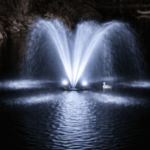
Lighting can be used to make a fountain visible after sunset.
Pond fountain lights are commonly designed as LED fixtures that illuminate the water spray. Depending on the installation, lights may be mounted on or around the floating fountain and positioned to highlight the spray pattern.
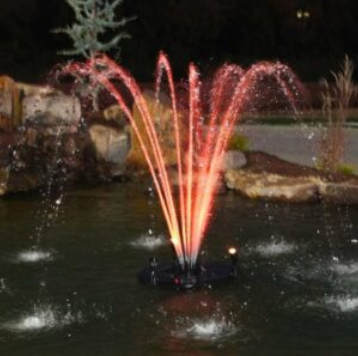
Some fountain systems are specifically designed to accept optional lighting kits. Published specifications for certain 1/3 HP systems list optional white and color-changing lighting configurations.
Lighting should be treated as an electrical installation around water, so suitable equipment and appropriate protection are essential.
What Are the Benefits of Fountain Lighting?
Lighting can transform a fountain’s appearance during the evening.
A well-positioned light can make individual streams or droplets more visible and turn the fountain into a focal point within a landscape.
White lighting generally emphasizes the natural appearance of water, while color-changing systems can create different visual effects.
The number, position, brightness, and beam direction of fixtures all influence the final result.
Lighting should also be balanced with the surrounding landscape so that it improves visibility without creating unnecessary glare.
What Should You Consider Before Buying a 1/3 HP Fountain?
Several factors should be evaluated before choosing a system:
- Pond surface area
- Pond depth
- Desired spray height
- Desired spray width
- Pump flow rate
- Nozzle type
- Electrical requirements
- Anchoring method
- Maintenance requirements
- Operating schedule
- Lighting compatibility
The most suitable fountain is not necessarily the one with the highest flow rate.
A fountain should be matched to the physical dimensions and purpose of the pond. Oversizing can increase energy use and create excessive spray, while undersizing may provide insufficient circulation or visual impact.
Conclusion
A 1/3 HP pond fountain can provide an effective combination of water movement, surface aeration, and decorative appeal when it is properly matched to the pond. Motor horsepower is only one part of the equation; flow rate, nozzle configuration, operating depth, anchoring, and electrical requirements all affect performance. For evening use, pond fountain lights can add another dimension by illuminating the spray and making the fountain visible after dark. Any lighting installed around water should be suitable for the environment and connected using appropriate electrical safety measures.
Author

