




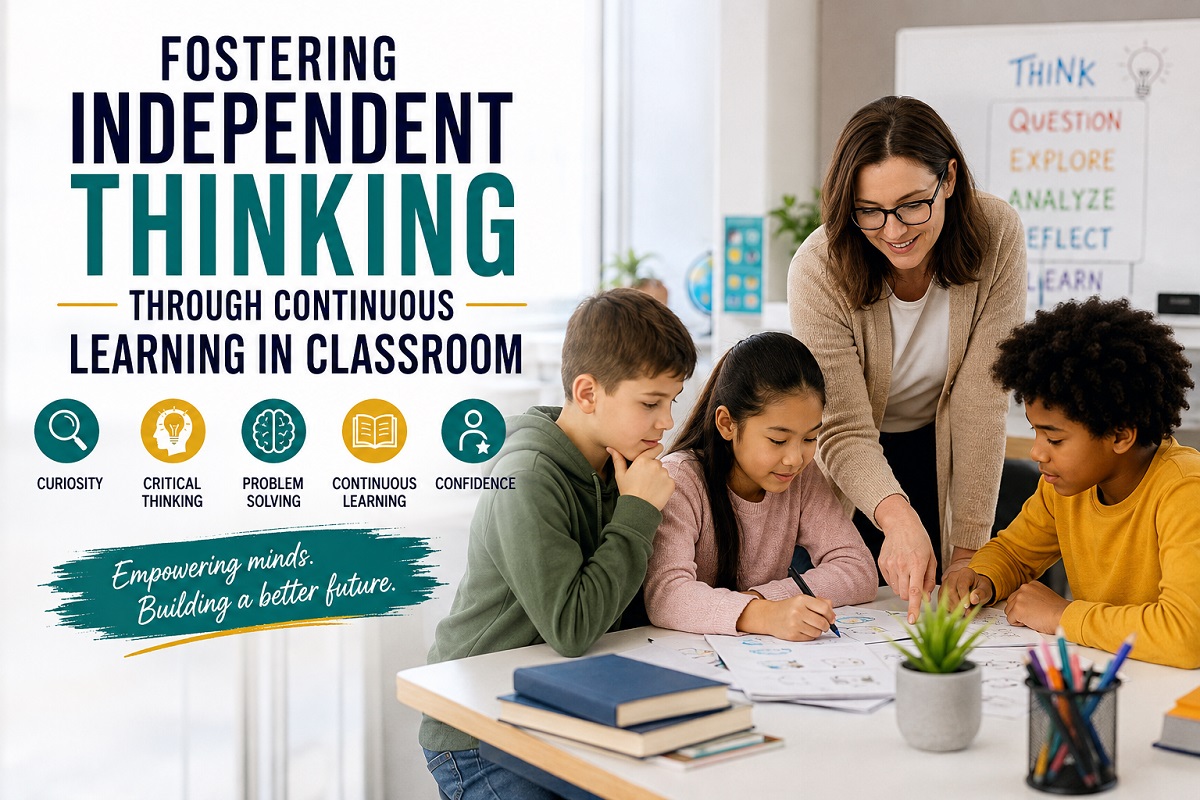
Fostering Independent Thinking Through Continuous Learning in Classroom
Students do not become independent thinkers simply by memorizing lessons, completing worksheets, or getting high marks on exams. They develop that ability when classrooms give them regular opportunities to question ideas, investigate evidence, make decisions, learn from mistakes, and explain their reasoning.
That is why fostering independent thinking through continuous learning in classroom should be treated as an ongoing teaching practice rather than a single classroom activity.
A student who learns how to think independently can approach an unfamiliar mathematics problem, evaluate conflicting information online, challenge an assumption respectfully, design a science experiment, or decide which solution makes the most sense in a real-world situation. These skills matter well beyond school. They influence higher education, careers, relationships, financial decisions, and everyday problem-solving.
For teachers, the challenge is finding the right balance. Students need guidance, but they also need enough intellectual freedom to make meaningful choices. Technology can help, but simply putting a laptop or tablet in front of a learner does not create independent thinking.
The real goal is to build a classroom culture where learning continues because students become curious about the answers, not because someone is constantly telling them what to learn next.
What Is Independent Thinking in the Classroom?
Independent thinking is the ability to form judgments and make decisions using reasoning, evidence, knowledge, and reflection rather than automatically accepting someone else’s answer.
It does not mean that students should ignore teachers, textbooks, experts, or established knowledge. In fact, independent thinkers know when expert knowledge is reliable and when a claim needs further investigation.
A student demonstrating independent thinking might:
- Ask why a particular answer is correct.
- Compare two explanations before choosing one.
- Identify weaknesses in an argument.
- Look for evidence before accepting a claim.
- Explain a conclusion in their own words.
- Change their position when stronger evidence appears.
- Try a different strategy after an unsuccessful attempt.
- Connect classroom concepts with real-world situations.
- Ask questions that were not explicitly included in the assignment.
- Evaluate information from websites, social media, videos, and AI tools.
This distinction is important. Independent learning and independent thinking are related, but they are not identical.
A student can independently finish a worksheet while mechanically following instructions. Independent thinking requires intellectual ownership of the process.
Why Continuous Learning Strengthens Independent Thinking
Traditional education can sometimes make learning feel like a sequence:
Teacher explains → student memorizes → student takes test → class moves on.
Continuous learning creates a different cycle:
Question → explore → apply → receive feedback → reflect → revise → investigate further.
The second model gives students repeated opportunities to make decisions.
Consider a history lesson about industrialization. Instead of asking students to memorize dates and definitions, a teacher might provide factory photographs, worker accounts, economic data, and newspaper excerpts. Students could then investigate:
Did industrialization improve life for ordinary workers?
There is no value in immediately handing them the teacher’s preferred answer. Students need to examine evidence, recognize conflicting perspectives, develop a position, and defend it.
That process trains a transferable habit of mind.
Continuous Learning Creates Intellectual Momentum
Learning becomes more powerful when one question naturally produces another.
For example:
- A student learns how renewable energy works.
- They ask why some communities still rely heavily on fossil fuels.
- They investigate economics, infrastructure, geography, and policy.
- They compare different energy systems.
- They evaluate conflicting claims.
- They propose a realistic solution for a specific community.
The student has moved from consuming information to using information to investigate a problem.
That is the heart of independent thinking.
The Teacher’s Role Is Changing
Fostering independence does not mean the teacher becomes less important.
Quite the opposite.
An effective teacher becomes a designer of learning experiences, a source of expertise, a provider of feedback, and a person who knows when to step in and when to step back.
A useful classroom progression looks like this:
Stage 1: Model the Thinking
The teacher demonstrates how an expert approaches a problem.
Instead of simply solving a mathematics question, the teacher can verbalize the reasoning:
- What information do I have?
- What information is missing?
- Which strategy could work?
- What assumptions am I making?
- How can I check my answer?
Students see that strong thinking is a process rather than a magical ability.
Stage 2: Think Together
The teacher and students work through a problem collaboratively.
Different students suggest approaches. The teacher asks probing questions rather than immediately identifying the correct answer.
Stage 3: Guided Independence
Students work individually or in groups while the teacher provides limited support.
If a learner says, “I don’t know what to do,” instead of supplying the answer, the teacher might ask:
“What have you tried so far?”
or:
“Which part of the problem do you understand?”
Stage 4: Genuine Independence
Students decide how to investigate a question, which resources to use, how to present their findings, and how to evaluate the result.
The teacher remains available, but the intellectual responsibility increasingly belongs to the learner.
Ask Better Questions Instead of Giving Faster Answers
One of the simplest ways to encourage independent thinking is to improve classroom questioning.
Questions such as “What is the answer?” usually focus attention on correctness.
Questions such as these focus attention on reasoning:
- Why do you think that?
- What evidence supports your idea?
- What would change your mind?
- Is there another possible explanation?
- Which source would you trust more, and why?
- What assumption are we making?
- Can you find a counterexample?
- How would this work in a different situation?
- What happens if we change one variable?
- How could you test your prediction?
The difference may seem small, but it changes the student’s role.
They are no longer trying only to guess what the teacher wants to hear. They are being asked to construct and defend an explanation.
Use Follow-Up Questions
The strongest discussions often happen after a student gives an answer.
Suppose a student says:
“This company is successful because its product is popular.”
Rather than saying “Correct,” the teacher can ask:
“What evidence tells us the product is responsible for that success?”
The student may then examine revenue, customer retention, competition, marketing, pricing, or market conditions.
One answer becomes the starting point for deeper investigation.
Give Students Problems Without Immediate Solutions
Students cannot develop independent judgment if every classroom problem comes with a predetermined procedure.
Open-ended problems create productive uncertainty.
For example, in a science classroom, instead of saying:
“Follow these five steps to test evaporation.”
A teacher could ask:
“How could we design an experiment to determine which environmental factors affect the rate of evaporation?”
Now students have to consider:
- What should be measured?
- What variables should remain constant?
- What equipment is required?
- How many trials are necessary?
- How should the results be recorded?
- What would count as convincing evidence?
The teacher still teaches scientific principles, but students are responsible for applying them.
Build Choice Into Assignments
Choice is one of the most practical tools for encouraging intellectual ownership.
Students might be allowed to choose:
- The topic they investigate.
- The question they want to answer.
- The resources they consult.
- The format of their final project.
- The method they use to solve a problem.
- The audience for their presentation.
- The real-world issue they want to connect with the lesson.
For example, a digital literacy project could ask students to investigate a misleading claim circulating online.
One student might create a fact-checking report. Another could produce a short video. A third could build an evidence comparison chart.
The learning objective remains consistent while the path differs.
This is particularly valuable for teenagers and adult learners because autonomy can increase their sense of responsibility for the work.
Teach Students How to Evaluate Information
Independent thinking is impossible without information literacy.
Today’s students can encounter thousands of claims before breakfast through search engines, social networks, videos, blogs, advertisements, and AI-generated content.
The classroom therefore needs to teach a practical question:
“How do I know this is true?”
Students should learn to examine:
Source
Who created the information?
Evidence
What data, research, documents, or observations support the claim?
Purpose
Is the creator trying to inform, sell, persuade, entertain, or provoke?
Date
Is the information current enough for the question being investigated?
Corroboration
Do credible independent sources support the same conclusion?
Method
If research is being cited, how was the evidence collected?
A student who learns these habits is better equipped to evaluate information outside school.
Use Technology as a Thinking Tool, Not an Answer Machine
Technology can support independent learning, but it can also reduce thinking when students use it simply to obtain answers.
Search engines, educational platforms, simulations, collaborative documents, coding environments, and AI tools can all be valuable when students remain responsible for evaluating the output.
For example, instead of asking students to use an AI system to write an essay, a teacher could ask them to:
- Develop their own argument.
- Research supporting evidence.
- Use an AI tool to generate an alternative viewpoint.
- Identify weaknesses or inaccuracies in that response.
- Compare the AI-generated position with reliable sources.
- Revise their original argument based on evidence.
- Explain what they changed and why.
The technology becomes an object of critical analysis rather than a substitute for thinking.
Teach AI Verification
For older students and adult learners, this is increasingly important.
A generated answer may sound convincing while containing:
- Incorrect facts.
- Unsupported claims.
- Missing context.
- Outdated information.
- Fabricated citations.
- Overconfident conclusions.
Students should understand that fluent writing is not proof of accuracy.
The key classroom question becomes:
“What evidence would you need before trusting this answer?”
That question develops a skill that remains useful regardless of which technology students use in the future.
Make Mistakes Part of the Learning Process
Students often avoid independent thinking because they believe mistakes will immediately lead to poor grades or embarrassment.
A classroom that treats every error as failure encourages risk avoidance.
A classroom that treats errors as information encourages experimentation.
Consider a mathematics lesson.
A student uses an incorrect strategy and receives the wrong answer. Instead of immediately correcting it, the teacher asks:
- Where did the reasoning change direction?
- What assumption caused the problem?
- Which part of the method was actually useful?
- How could you modify the strategy?
The student learns something more valuable than the correct answer: how to diagnose their own thinking.
Use Revision as a Learning Skill
Assignments can include a short reflection:
- What was your original approach?
- What did you discover?
- What feedback changed your thinking?
- What would you do differently next time?
This makes reflection a normal part of academic work.
Create Classroom Discussions Where Students Can Disagree
Independent thinkers need practice expressing disagreement without turning discussion into personal conflict.
Teachers can establish simple rules:
- Challenge ideas, not people.
- Provide reasons for important claims.
- Ask questions before rejecting an argument.
- Distinguish evidence from personal preference.
- Allow people to revise their position.
- Do not treat disagreement as disrespect.
A classroom discussion about technology, business, environmental policy, literature, or social issues can become a powerful exercise in reasoning.
The objective is not for everyone to reach the same opinion.
The objective is for students to understand why they hold a position and what evidence could challenge it.
Project-Based Learning Makes Independence Visible
Projects are particularly useful because they combine knowledge with decision-making.
A strong project might require students to:
- Identify a problem.
- Research its causes.
- Evaluate possible solutions.
- Select an approach.
- Create a product or proposal.
- Test or present it.
- Collect feedback.
- Improve the result.
Imagine a business class asking students to design a small local business concept.
Students must decide:
- Who is the customer?
- What problem does the business solve?
- What will it cost?
- Who are the competitors?
- How will customers discover it?
- What evidence suggests demand exists?
- What could cause the idea to fail?
There is no single correct answer.
That uncertainty is precisely what makes the activity valuable.
Connect Classroom Learning to Real Problems
Independent thinking becomes stronger when students understand why knowledge matters.
A physics concept can be connected to vehicle safety.
Statistics can be connected to sports performance or business decisions.
Writing can be connected to persuasive communication.
Computer science can be connected to automation.
Economics can be connected to household budgeting.
Geography can be connected to supply chains.
Environmental science can be connected to local water or waste-management issues.
The question for teachers is often simple:
“Where would someone actually use this knowledge?”
Once students see that connection, classroom learning becomes less about collecting information and more about developing usable judgment.
Encourage Students to Teach One Another
Peer teaching creates an interesting shift in responsibility.
When students know they must explain an idea to someone else, they often discover gaps in their own understanding.
Try activities such as:
Students first develop an individual response, then compare it with a partner before sharing with the class.
Student-Led Explanation
A student explains a concept while classmates ask questions.
Peer Review
Students evaluate one another’s work using clear criteria.
Debate
Teams defend competing positions using evidence.
Teach-Back
After learning a concept, students explain it as if they were teaching a beginner.
These activities give learners repeated opportunities to articulate reasoning rather than simply reproduce information.
Build a Classroom Culture of Curiosity
Independent thinkers ask questions because questions are welcomed.
Teachers can create a “question board” where students post questions connected to current lessons.
Not every question needs to be answered immediately.
Some can become future research topics.
For example:
Lesson: Artificial intelligence
Student question: “Why can AI give different answers to the same question?”
That question can lead to discussions about probability, training data, model behavior, prompt wording, and verification.
A curriculum becomes much more engaging when student curiosity helps shape the next lesson.
Assess Thinking, Not Just Final Answers
Assessment strongly influences student behavior.
If students are rewarded only for correct answers, they naturally optimize for correctness.
If assessment also values reasoning, students have an incentive to explain how they reached their conclusions.
Rubrics can include criteria such as:
| Skill | What to Look For |
|---|---|
| Reasoning | Clear explanation of how the conclusion was reached |
| Evidence | Relevant and credible support |
| Analysis | Comparison of different possibilities |
| Creativity | Original or appropriate approaches |
| Reflection | Recognition of mistakes and improvements |
| Communication | Clear explanation for the intended audience |
| Independence | Appropriate decision-making without excessive prompting |
This does not mean abandoning traditional tests.
Tests can still measure essential knowledge efficiently. But they should be combined with assignments that reveal how students use that knowledge.
A Practical Classroom Framework
Teachers looking for a repeatable approach can use the QUESTION → INVESTIGATE → CREATE → CHALLENGE → REFLECT cycle.
1. Question
Start with a meaningful problem rather than only a topic.
2. Investigate
Students gather information and determine which sources deserve trust.
3. Create
They develop an explanation, solution, experiment, argument, product, or presentation.
4. Challenge
Students test their assumptions through peer review, counterarguments, experiments, or additional evidence.
5. Reflect
Students identify what changed in their thinking and what they would investigate next.
This framework works across subjects because it focuses on the learning process rather than one particular curriculum.
Example: Applying the Approach Across Subjects
Mathematics
Instead of only solving equations, students can compare multiple solution strategies and explain which method is most efficient.
Science
Students can design experiments and predict outcomes before seeing the results.
English
Students can defend interpretations of a text using specific passages rather than searching for a predetermined interpretation.
History
Students can compare primary and secondary sources and identify differences in perspective.
Business
Students can analyze why a company succeeded or failed and defend their assessment using market evidence.
Computer Science
Students can design a solution, test it, identify bugs, and decide how to improve the system.
Media Studies
Students can investigate how headlines, images, statistics, and editing choices influence an audience.
The subject changes. The thinking habits remain.
Common Mistakes That Limit Independent Thinking
Even well-intentioned classrooms can unintentionally discourage independence.
Giving the Answer Too Quickly
When teachers immediately rescue students from difficulty, students learn to wait for assistance.
Better approach: Ask what they have already tried.
Making Every Task Highly Structured
Step-by-step instructions are useful for beginners, but excessive structure prevents students from making decisions.
Better approach: Gradually remove scaffolding as competence increases.
Treating One Answer as the Only Acceptable Response
Some questions genuinely have one correct answer. Others involve interpretation, strategy, or judgment.
Better approach: Distinguish factual accuracy from reasonable differences in approach.
Using Technology Without Teaching Evaluation
Having access to information does not mean students know how to assess it.
Better approach: Make source evaluation part of the assignment.
Grading Every Experiment
If every attempt receives a high-stakes grade, students may avoid ambitious ideas.
Better approach: Use low-stakes experimentation followed by revision.
Confusing Independence With Isolation
Students can think independently while collaborating.
Better approach: Ask students to develop individual positions before comparing them with peers.
How Parents Can Reinforce Independent Thinking
Independent thinking does not stop when school ends.
Parents and caregivers can support the same habits through ordinary conversations.
Instead of always asking:
“Did you get the right answer?”
try:
- “How did you figure it out?”
- “What made you choose that option?”
- “What evidence did you find?”
- “What would you do differently?”
- “What do you think the other side would say?”
- “Where could we check that information?”
These questions communicate an important message: the reasoning process matters.
Parents can also encourage young people to plan small projects, research personal interests, manage age-appropriate responsibilities, and make decisions with clear consequences.
How Students Can Practice Independent Thinking Every Day
Students do not need to wait for a special classroom project.
A simple daily routine can help.
Before accepting a claim
Ask:
Who says this, and what evidence supports it?
When solving a difficult problem
Ask:
What do I already know that could help?
When you make a mistake
Ask:
Where did my reasoning go wrong?
When two sources disagree
Ask:
Which source has stronger evidence and why?
When someone challenges your opinion
Ask:
What part of their argument should I investigate?
After completing an assignment
Ask:
What can I now explain that I couldn’t explain before?
These habits gradually turn learning into an active process.
Measuring Progress in Independent Thinking
Independent thinking is not always easy to measure with a single score.
Teachers can watch for behavioral changes over time.
Signs of progress include students who:
- Ask increasingly specific questions.
- Need fewer prompts to begin difficult tasks.
- Use evidence more consistently.
- Explain reasoning without being asked repeatedly.
- Seek multiple sources.
- Detect weaknesses in their own work.
- Revise their ideas after receiving evidence.
- Suggest alternative solutions.
- Become comfortable saying, “I don’t know yet.”
- Begin investigating questions beyond the assignment.
That last point is particularly meaningful.
When a student starts asking questions that the teacher did not assign, learning has begun to become self-directed.
Why This Skill Matters Beyond the Classroom
The modern workplace changes too quickly for people to depend entirely on what they learned during formal education.
Employees may need to learn unfamiliar software, interpret new data, understand changing customer behavior, evaluate AI-generated information, or solve problems that have no existing template.
Entrepreneurs face the same challenge.
So do university students.
So does anyone trying to make sensible decisions in a world filled with competing information.
The long-term value of education is therefore not simply remembering what was taught. It is developing the ability to learn, question, evaluate, adapt, and continue learning when circumstances change.
That is the deeper purpose behind fostering independent thinking through continuous learning in classroom.
Building the Classroom of the Future
The most effective classrooms of the future will not necessarily be those with the most technology.
They will be the classrooms where students can:
- Ask difficult questions without fear.
- Access high-quality information.
- Distinguish evidence from opinion.
- Experiment without being punished for every mistake.
- Work collaboratively while developing their own judgments.
- Use technology critically.
- Receive useful feedback.
- Revise their thinking.
- Pursue questions beyond the textbook.
Teachers remain central to this environment because independence does not develop automatically. It needs structure, modeling, feedback, appropriate challenge, and opportunities for genuine choice.
The goal is not to produce students who never ask for help. A genuinely independent learner knows when help is necessary.
The goal is to produce learners who can say:
“I don’t know the answer yet, but I know how to start finding it.”
That mindset can carry a student from the classroom into university, work, entrepreneurship, and lifelong learning. As education continues to evolve, classrooms that consistently develop curiosity, judgment, reflection, and intellectual ownership will give learners something far more durable than a collection of memorized answers: the ability to keep learning on their own.
Author

