




CNC Vertical Machining: Uses, Benefits, and How It Works
Modern manufacturing depends on precision, repeatability, and efficient production methods. As manufacturers face increasingly complex components and tighter dimensional requirements, computer numerical control (CNC) machining has become an important part of many production environments. Among the different CNC configurations available, vertical machining is widely used for producing components across industries such as aerospace, automotive, medical equipment, and general engineering.
Understanding CNC vertical machining involves looking at how these machines operate, what components they can produce, and how different machine configurations affect manufacturing capabilities. The vertical arrangement can provide practical advantages for particular machining operations while allowing manufacturers to perform multiple processes on a single machine.
What Is CNC Vertical Machining?
CNC vertical machining is a manufacturing process in which computer-controlled cutting tools remove material from a workpiece to create a precise shape. In a vertical machining configuration, the spindle is oriented vertically, meaning the cutting tool moves downward toward the workpiece.
The CNC controller coordinates movements along multiple axes according to programmed instructions. Depending on the machine’s configuration, these movements can include linear X, Y, and Z axes as well as additional rotational axes.
This automated approach allows manufacturers to repeatedly produce components according to specified dimensions. CNC machining can work with materials such as aluminum, steel, stainless steel, titanium, plastics, and various engineered materials, although the appropriate cutting parameters depend on the material and application.
How Does a Vertical Machining Center Work?
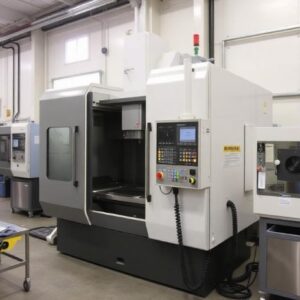
A typical CNC vertical machining center consists of several major components, including the spindle, worktable, cutting tools, CNC controller, drive system, and machine frame.
The manufacturing process generally begins with a digital CAD model. CAM software can then convert the design into machine instructions that determine tool paths, cutting speeds, feeds, and other parameters.
Once the workpiece is secured to the table, the machine executes the programmed operations. These may include:
- Face milling
- Pocket milling
- Drilling
- Tapping
- Contouring
- Slotting
- Boring
- Reaming
Modern machining centers can often perform multiple operations without removing the workpiece from the machine. This can improve consistency by reducing the number of times a component must be repositioned.
What Are the Main Benefits?
One of the primary advantages of CNC vertical machining is precision. Computer-controlled movement allows machines to follow programmed tool paths with high repeatability.
Another benefit is production efficiency. Once a program has been developed and verified, the same machining sequence can be repeated across multiple workpieces. This makes CNC equipment suitable for both prototype development and larger production runs.
Vertical machines can also provide good visibility and accessibility around the work area. Depending on the design, this can make setup, inspection, and workpiece loading more convenient.
Automation can further reduce the amount of manual intervention required during machining. Tool changers, probing systems, coolant systems, and automated workholding can increase productivity and reduce setup-related interruptions.
What Is a 5-Axis Vertical Machining Center?
A 5 axis vertical machining center expands machining capabilities beyond the three standard linear axes. Five-axis machines can coordinate three linear movements with two rotational movements, allowing the cutting tool or workpiece to be positioned from multiple directions.
This configuration is particularly useful when manufacturing components with complex surfaces, angled features, deep cavities, or difficult-to-access geometries.
A five-axis machine can often reach several surfaces of a component without requiring as many manual repositioning operations. Reducing repositioning can improve accuracy because the workpiece remains in a controlled setup for more of the machining process.
However, five-axis machining also requires more sophisticated programming, tooling strategies, workholding, and operator knowledge. The additional capabilities are most valuable when the component’s geometry actually benefits from multi-axis movement.
Choosing Between Three-Axis and Five-Axis Machining
Not every manufacturing application requires five-axis equipment. Three-axis vertical machining can be highly effective for components with relatively accessible surfaces and straightforward geometries.
Five-axis equipment becomes more attractive when parts contain complex contours or features that are difficult to machine efficiently using multiple setups.
When selecting equipment, manufacturers should consider:
- Part geometry
- Required tolerances
- Production volume
- Material
- Number of required setups
- Tool accessibility
- Cycle time
- Programming requirements
- Available floor space
- Future production needs
Choosing a machine based solely on the number of axes may not produce the most efficient solution. The machine’s spindle characteristics, travel ranges, work envelope, tooling system, controller, and automation capabilities can be equally important.
What Industries Use Vertical CNC Machines?
CNC vertical machining is used across a wide range of manufacturing sectors. Automotive manufacturers may use vertical machines for engine, transmission, and structural components. Aerospace manufacturers can use advanced machining systems to produce complex metal components with demanding dimensional requirements.
Medical manufacturing is another important application, particularly for precision components and instruments. General machine shops also use vertical machining equipment because of its versatility across different jobs.
The ability to change tools automatically and program repeatable machining sequences makes these machines suitable for both standardized components and customized production work.
How Can Manufacturers Improve Machining Efficiency?
Efficient CNC machining depends on more than machine specifications. Tool selection, programming, workholding, cutting parameters, coolant management, and preventative maintenance all influence production performance.
Proper workholding is particularly important because movement or vibration during cutting can affect dimensional accuracy and surface finish. Tool condition should also be monitored because worn cutting tools can increase cycle times and negatively affect part quality.
Manufacturers can additionally analyze machining data to identify bottlenecks, excessive tool changes, long setup times, and other sources of lost productivity.
Conclusion
CNC vertical machining provides manufacturers with a flexible and automated method for producing precise components across many industries. The vertical spindle configuration can support a broad range of milling, drilling, tapping, and contouring operations while reducing manual intervention. For more complex components, a CNC vertical machining center with additional axes can provide greater access to difficult features and reduce the need for multiple setups. A 5 axis vertical machining center can be particularly useful for intricate geometries, although its benefits should be evaluated against the application’s programming and production requirements. Ultimately, selecting the right machining configuration requires consideration of part design, materials, tolerances, production volume, tooling, and long-term manufacturing objectives.
Author

