




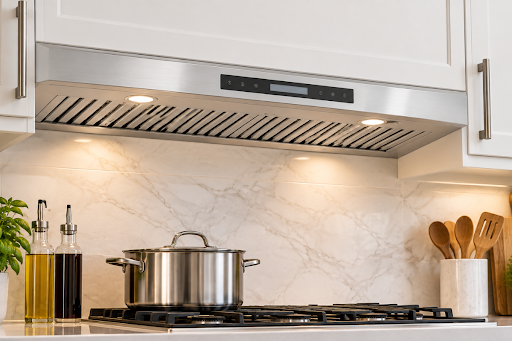
A Complete Guide to Choosing Ductless Under-Cabinet Range Hoods
Kitchen ventilation helps control cooking odors, smoke, grease, and airborne particles, but not every kitchen has the space or structure required for exterior ductwork. Ductless under-cabinet range hoods offer an alternative by filtering cooking air and returning it to the kitchen. Their compact configuration also makes them suitable for kitchens where cabinet space and layout are important considerations. Before choosing one, however, homeowners should understand how filtration works, what features matter, and how maintenance affects performance.
How Ductless Range Hoods Work
Unlike ducted ventilation systems, a ductless hood does not send kitchen air outside. Instead, a fan draws air upward from the cooking surface and passes it through filters. Grease filters capture airborne grease particles, while activated charcoal or carbon filters help reduce cooking odors before filtered air is released back into the room.
Because the air remains inside the kitchen, these systems do not remove heat, humidity, or cooking byproducts as completely as an externally vented system. However, they can provide useful filtration where installing ductwork is impractical.
Why Under-Cabinet Installation Is Practical
Under-cabinet hoods are designed to fit beneath kitchen cabinets positioned above the cooking area. This configuration can make efficient use of existing space without requiring a separate chimney-style structure.
For smaller or compact kitchens, ductless under-cabinet range hoods can provide ventilation without major changes to cabinetry or walls. Their relatively straightforward installation can also make them an option for remodeling projects where existing construction limits the ability to add new duct routes.
Before installation, it is important to confirm the available cabinet dimensions and the hood’s required clearance above the cooking surface.
Understanding Filtration
Filter design is one of the most important considerations when choosing a ductless hood. Grease filters help prevent oil and cooking residue from entering the internal fan and surrounding areas. Depending on the model, these may be aluminum mesh, baffle-style, or another washable design.
Odor filtration is handled separately through carbon or charcoal filters. These filters have a limited service life and gradually become less effective as they absorb cooking odors. Replacement intervals depend on cooking frequency and the manufacturer’s recommendations.
Regular filter maintenance is therefore essential. A dirty grease filter can restrict airflow, while an exhausted carbon filter may no longer provide effective odor reduction.
Airflow and Fan Settings
Airflow capacity is another factor worth evaluating. Ductless systems rely on internal filtration, so the fan needs to move cooking air efficiently through the filters.
Multiple fan speeds can be useful because different cooking tasks generate different amounts of smoke and odor. Lower settings may be adequate for simmering, while higher settings can be useful when frying or cooking at high temperatures.
However, higher fan speed can also increase operating noise. Buyers should consider both airflow capability and noise levels rather than focusing on one specification.
Lighting and Controls
Practical features can make a range hood easier to use every day. Integrated lighting can illuminate the cooking surface, particularly when the hood is positioned beneath cabinets that block overhead light.
Controls should also be easy to access and operate. Push-button, touch, and other control systems may be available depending on the model. The most suitable option often comes down to personal preference and ease of cleaning.
For ductless under-cabinet range hoods, accessibility is particularly useful because filters require periodic removal and cleaning.
Maintenance Requirements
Ductless ventilation systems depend heavily on regular maintenance. Grease filters should be cleaned according to the manufacturer’s instructions, while carbon filters need replacement when their odor-absorbing capacity decreases.
The hood’s exterior should also be cleaned periodically to prevent grease and residue from accumulating around the controls, lighting, and intake areas. Before cleaning, users should follow the manufacturer’s safety instructions and disconnect power when required.
Conclusion
Choosing kitchen ventilation involves considering the layout, cooking habits, available installation space, filtration requirements, airflow, noise, and maintenance. For homeowners comparing different ventilation approaches, Top 5 Ducted Range Hoods: Complete Buying Guide can provide another perspective when evaluating externally vented alternatives. Ultimately, ductless under-cabinet range hoods are most useful when their filtration capabilities, installation advantages, and maintenance needs align with the kitchen’s specific requirements.
Author

