




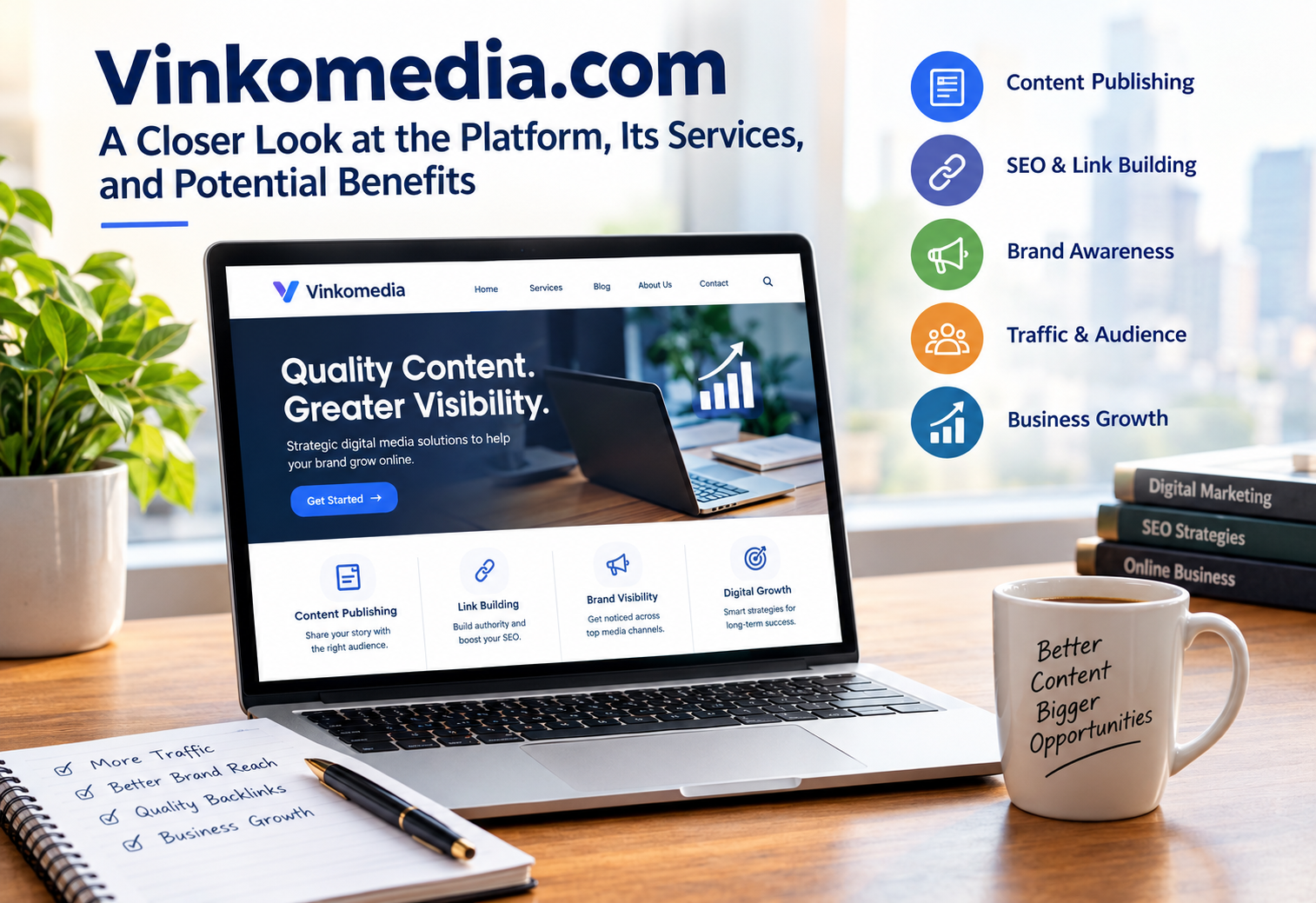
Vinkomedia.com: A Closer Look at the Platform, Its Services, and Potential Benefits
Choosing the right digital media partner can make a real difference for a business trying to reach new customers, build brand recognition, or improve its online presence. Vinkomedia.com is the subject of this guide, which explores how to assess the platform, what businesses should look for in a media service provider, and which details deserve attention before making a decision.
For US entrepreneurs, small business owners, marketing professionals, and startups, understanding a company’s services before investing time or money is a sensible first step. A website’s name and appearance alone cannot tell you whether its services match your goals.
This guide examines Vinkomedia.com through the lens of digital media, online marketing, business value, and customer due diligence. Specific services, company credentials, and pricing should be confirmed directly through the website or other reliable sources rather than assumed.
What Is Vinkomedia.com?
Vinkomedia.com is a domain associated with online publishing and media-related content in third-party listings. The website has also been discussed in the context of SEO, guest posting, content distribution, and digital marketing.
The available article on Startup.info presents Vinkomedia.com as a platform for publishing content, building brand visibility, and supporting link-building campaigns. However, I could not independently verify all the service descriptions or performance claims because the site’s main domain restricted direct access during research.
For that reason, readers should distinguish between what third-party sources report and what the website itself confirms.
Why Are Businesses Interested in Digital Publishing?
Digital publishing gives companies another way to introduce their expertise to people who may not have encountered their brand before.
A well-placed article can help a business:
-
Explain its products or services to a relevant audience.
-
Share practical advice related to its industry.
-
Establish a recognizable brand identity.
-
Attract visitors from external websites.
-
Build relationships with publishers, editors, and industry professionals.
-
Support a broader content marketing and SEO strategy.
These benefits depend on the publication, its readership, the quality of the article, and the relevance of the audience. Simply publishing an article does not guarantee more customers or better Google rankings.
How Vinkomedia.com May Fit Into a Digital Marketing Strategy
Businesses considering Vinkomedia.com should begin by identifying the service they need and confirming that the platform provides it.
A useful marketing strategy connects every activity to a specific business objective. For example, a startup seeking brand recognition needs a different approach from an established online store trying to attract qualified search traffic.
1. Content Publishing and Brand Awareness
Publishing informative articles on relevant websites can introduce a brand to readers outside its existing audience.
Imagine a US-based software startup that sells inventory management tools to small retailers. An educational article about reducing inventory errors could reach business owners looking for practical advice.
If the article appears on a publication with a relevant readership, the company may gain brand exposure and qualified referral visits.
The same principle applies to other industries, including finance, technology, e-commerce, professional services, and entrepreneurship.
Before using Vinkomedia.com for content publishing, confirm:
-
Whether the platform accepts contributed articles.
-
Which subject categories it covers.
-
Whether articles undergo editorial review.
-
Whether commercial links are allowed.
-
Whether the publication charges a fee.
-
Whether published articles remain accessible over time.
These details help determine whether a placement suits your campaign.
2. SEO and Link Building
Search engine optimization involves improving a website’s ability to appear in relevant organic search results.
One part of SEO is earning links from other websites. A relevant editorial link can help search engines discover pages and understand how websites and topics relate to one another.
However, a backlink is not a guarantee of higher rankings. Its value depends on factors such as editorial context, relevance, the linking page, and whether the link complies with search engine policies.
Google’s guidance warns against buying or selling links intended to manipulate search rankings. Paid placements should use appropriate link attributes, such as rel="sponsored", where applicable.
If you are considering Vinkomedia.com for SEO, evaluate the actual publishing page instead of relying only on a domain authority score.
Look for:
-
Relevant subject matter.
-
Original and useful editorial content.
-
Evidence of real readership.
-
A clear separation between editorial material and advertising.
-
A transparent policy for sponsored articles.
-
A natural reason for readers to visit the linked website.
A smaller publication with an engaged, relevant audience may offer more business value than a site with impressive SEO metrics but little genuine readership.
3. Content Distribution
Creating an article is only one part of content marketing. Businesses also need to get that article in front of the people who are likely to benefit from it.
Content distribution can involve several channels:
-
Industry publications and online magazines.
-
Company blogs and resource centers.
-
Email newsletters.
-
Professional social networks.
-
Relevant business communities.
-
Partnerships with subject experts.
A platform such as Vinkomedia.com may fit into this process if its publishing options, audience, and editorial standards align with your goals.
The best approach is to treat each publication as one part of a broader distribution plan rather than depending on a single website to generate all your traffic.
Evaluating Vinkomedia.com Before Using It
Choosing a publishing website requires more than checking a domain rating or a quoted backlink price.
The following framework can help US businesses and marketing agencies assess whether a placement deserves their budget.
Check Website Traffic and Audience Quality
Traffic estimates from SEO tools can provide a useful starting point, but they are not the same as verified analytics.
Review several indicators together:
-
Estimated organic search traffic.
-
Search visibility over the past six to twelve months.
-
The types of keywords the website ranks for.
-
Whether indexed articles receive relevant search exposure.
-
The geographic distribution of its audience, where reliable data is available.
-
Whether the site’s content attracts meaningful engagement.
For businesses targeting US customers, audience geography matters. A publication may have a reasonable global readership but very little reach in the United States.
Ask the publisher for suitable evidence if US readership is central to your decision.
Review the Backlink Profile
Third-party SEO metrics can help compare websites, but they should not decide the purchase on their own.
Before buying a guest post or sponsored article, investigate the referring domains and the quality of the pages linking to the publication.
Watch for patterns such as:
-
Large numbers of unrelated websites linking to the domain.
-
Suspicious spikes in backlinks without a clear explanation.
-
Repeated keyword-heavy anchor text.
-
Many articles published across unrelated commercial niches.
-
Pages created primarily to sell links rather than inform readers.
One unusual metric does not prove that a website is low quality. The goal is to identify patterns that could make a placement less useful or riskier.
Confirm Editorial Standards
A publication’s editorial practices offer important clues about its quality.
A trustworthy publishing process should make clear how articles are submitted, reviewed, edited, and published.
Before working with Vinkomedia.com, ask whether the team:
-
Reviews content for originality.
-
Checks factual claims and sources.
-
Rejects irrelevant or misleading promotional content.
-
Identifies sponsored material appropriately.
-
Maintains published articles after publication.
-
Provides a clear process for corrections.
If every submitted article is accepted automatically regardless of its quality, that may be a reason to investigate further.
Pros and Cons of Using a Content Publishing Platform
The benefits of a publishing partnership depend on the specific website and its audience. Here is a practical overview of the potential advantages and limitations.
| Potential advantages | Possible limitations |
|---|---|
| Opportunities to reach new readers | Audience size may be difficult to verify |
| Additional brand mentions | Brand exposure may not generate leads |
| Referral traffic from relevant articles | Traffic levels may be modest |
| Opportunities to demonstrate expertise | Content creation takes time and research |
| Potential SEO benefits from appropriate editorial links | Rankings are never guaranteed |
| Additional content distribution channels | Sponsored placements may require payment |
For Vinkomedia.com specifically, these are potential benefits of the publishing model, not verified results from a tested campaign.
A sound decision depends on the actual placement, the price, the audience, and the outcome you expect.
How to Build an Effective Content Campaign Around Vinkomedia.com
If the platform meets your requirements, a structured campaign can help you measure its value.
Step 1: Define Your Primary Objective
Choose one main goal before commissioning an article.
Possible objectives include:
-
Building awareness among US business owners.
-
Introducing a new product or service.
-
Attracting visitors to a useful resource.
-
Reaching a specific industry audience.
-
Earning legitimate editorial coverage.
-
Supporting a broader public relations campaign.
Clear objectives make it easier to choose topics, evaluate publications, and measure results.
Step 2: Select a Topic That Fits the Audience
An article should solve a problem that readers actually have.
For example, a cybersecurity company might publish a guide to protecting customer data. A financial technology startup could explain how small businesses can manage recurring payments. An e-commerce company might examine common checkout problems and practical ways to address them.
Avoid generic articles written solely to insert a link. Useful content gives readers a reason to engage with the brand.
Step 3: Prepare Original, Evidence-Based Content
A strong contributed article should offer something beyond information readers can find in dozens of existing posts.
Consider including:
-
Recent and relevant research.
-
Expert commentary.
-
Clearly explained examples.
-
Practical instructions.
-
Original comparisons or analysis.
-
Links to reliable primary sources.
Check statistics before publication, and identify the source and date for any figures used.
If you are publishing for a US audience, use familiar terminology, US spelling, and examples relevant to American businesses.
Step 4: Use Links Naturally
Links should help readers explore a relevant subject or source.
For instance, an article about business accounting might link to a detailed guide explaining bookkeeping practices. That is more useful than inserting a commercial keyword into an unrelated paragraph.
Use descriptive anchor text that accurately reflects the destination page. Avoid forcing exact-match keywords into every placement.
For paid articles, follow the publisher’s disclosure rules and Google’s link qualification guidance.
Step 5: Track Results After Publication
Measure the campaign using data that connects to your original objective.
| Metric | What it tells you |
|---|---|
| Referral sessions | Whether readers visit your website |
| Engaged sessions | Whether visitors interact with your content |
| Conversions | Whether visitors complete useful actions |
| Search Console impressions | Whether your pages appear in Google search |
| Search clicks | Whether search visibility generates visits |
| Qualified leads | Whether the campaign attracts potential customers |
| Publication status | Whether the article remains live and accessible |
Google Analytics can help track referral visits and conversions. Google Search Console can help monitor search impressions, clicks, and indexing.
Do not attribute every ranking change to one article. Search performance can change for many reasons, including competition, technical issues, content quality, and changes in search results.
Common Mistakes to Avoid
Buying Links Based Only on Domain Authority
A high authority score from an SEO tool does not guarantee genuine readership, editorial quality, or improved rankings.
Review the website’s content, traffic patterns, audience, and backlink profile before spending money.
Publishing the Same Article Everywhere
Submitting identical content to many websites can create a weak content campaign and reduce its usefulness to readers.
Prepare original material for each publication when possible. Adapt the angle, examples, and structure to match the intended audience.
Expecting Immediate Ranking Improvements
Search engines do not promise a specific indexing date or ranking improvement after publication.
An article might be discovered quickly but generate little traffic. Another might attract useful referral visitors without noticeably changing search positions.
Evaluate results over a reasonable period and focus on business outcomes rather than guaranteed ranking timelines.
Ignoring the Quality of Your Own Website
External publishing cannot compensate for a confusing website, slow pages, weak landing pages, or an unclear offer.
Before investing in outreach, make sure your destination pages provide useful information, work properly on mobile devices, and give visitors a clear next step.
Overlooking Paid-Link Policies
Paying for an article and paying for a ranking-manipulating link are not the same thing.
Sponsored content can serve legitimate marketing purposes. However, links purchased primarily to manipulate organic rankings can violate Google’s spam policies. Disclose paid relationships and qualify links appropriately.
Is Vinkomedia.com Worth Considering for US Businesses?
Vinkomedia.com may be worth investigating if you are exploring publishing opportunities, sponsored articles, or additional channels for online visibility.
The key question is whether the platform can connect your business with a relevant audience at a reasonable cost.
A US business targeting local customers, for example, may get better results from a respected regional publication than from a website with a broad but unrelated audience. A national technology company may prefer an industry publication with readers who influence purchasing decisions.
Before committing, compare the platform with two or three alternatives using the same criteria:
-
Audience relevance.
-
Verifiable traffic and search visibility.
-
Editorial standards.
-
Total publishing cost.
-
Link and sponsorship policies.
-
Potential referral traffic.
-
Measurable business outcomes.
The comparison should reflect your campaign goals rather than simply identifying the site with the highest advertised SEO score.
Frequently Asked Questions About Vinkomedia.com
1. What is Vinkomedia.com?
Vinkomedia.com is a website discussed in third-party publishing and SEO listings. Startup.info describes it in connection with digital publishing, content distribution, and search visibility. Its current services should be confirmed directly with the website.
2. Can Vinkomedia.com help with SEO?
A relevant editorial placement may support brand visibility, referral traffic, and content discovery. However, no placement can guarantee improved rankings. Results depend on content quality, relevance, technical SEO, competition, and other factors.
3. Does Vinkomedia.com accept guest posts?
I could not independently confirm its current guest-post submission policy. Contact the website directly to ask about contributor requirements, supported categories, editorial review, publication fees, and sponsorship disclosures.
4. Is Vinkomedia.com suitable for US businesses?
It may be suitable if its audience and subject coverage match your target market. Check whether it reaches US readers in your industry and whether its content attracts the kind of visitors your business wants.
5. How much does publishing on Vinkomedia.com cost?
I could not verify an official current price list. Request a written quote covering content requirements, editing, publication, sponsored links, disclosure, and any additional charges before ordering.
6. How can I check Vinkomedia.com’s SEO value?
Use tools such as Ahrefs, Semrush, and Google search to examine organic visibility, referring domains, indexed content, and topical relevance. Treat third-party traffic estimates and authority scores as estimates, not proof of actual readership.
7. Will a backlink from Vinkomedia.com improve Google rankings?
There is no guarantee. Google evaluates many signals, and paid links intended to manipulate rankings can violate its spam policies. Focus on relevant editorial coverage, useful content, and qualified visitors rather than a promised ranking increase.
8. How long does it take to see results from a publishing campaign?
Referral traffic may appear soon after an article goes live, but the timing varies. Search visibility and business conversions can take longer, and some placements may produce little measurable impact. Monitor results instead of relying on fixed ranking timelines.
Final Thoughts on Vinkomedia.com
Vinkomedia.com is a platform worth researching if your marketing strategy includes digital publishing, content distribution, or brand visibility. Its potential value depends on the quality of its publications, the relevance of its audience, and the terms it offers.
For US businesses, the smartest approach is to verify the website’s current services, inspect its real search visibility, and compare its publishing opportunities with other relevant platforms.
Prioritize original articles, credible sources, natural editorial context, and measurable business results. A publishing partnership should help readers discover useful information and give your business a legitimate opportunity to earn their attention. It should never depend on promises of guaranteed backlinks, instant indexing, or first-page rankings.
Author

