




Understanding the Right Key Steps in Health Care Waste Management
Healthcare facilities generate many different forms of waste every day, from ordinary packaging and paper to used sharps, contaminated materials, pharmaceuticals, chemicals, and other regulated waste. Because these materials can present different risks, they cannot all be handled through the same disposal process. Effective health care waste management creates a structured system for identifying, separating, storing, treating, and disposing of waste safely.
Identify Different Waste Categories
The first step is understanding what types of waste a facility produces. Healthcare waste can include general non-hazardous materials, infectious waste, sharps, pharmaceutical waste, chemical waste, pathological materials, and radioactive waste.
The World Health Organization estimates that approximately 85% of healthcare waste is general, non-hazardous waste, while the remaining 15% may be hazardous because it can be infectious, toxic, corrosive, reactive, or otherwise dangerous.
Correct classification helps determine the appropriate container, handling procedure, treatment method, and disposal route for each waste stream.
Segregate Waste at the Source
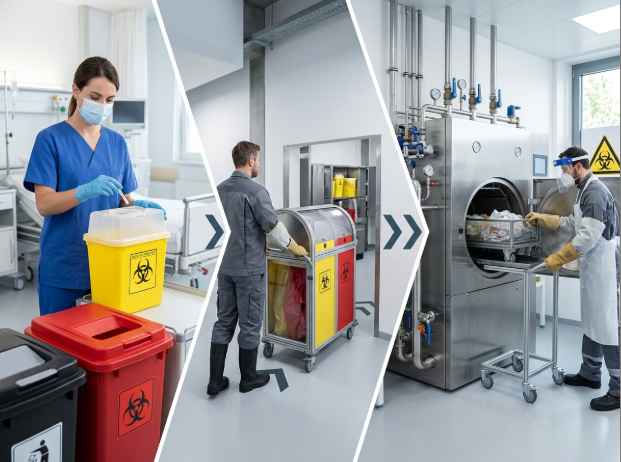
Waste segregation should happen as close as possible to where the waste is generated. This prevents hazardous materials from being mixed with general waste and reduces unnecessary exposure for healthcare workers and waste handlers.
The WHO recommends separate containers for different waste categories and emphasizes that hazardous and non-hazardous waste should remain separated during collection, storage, and transportation.
Sharps require particular attention because needles, blades, scalpels, and similar items can cause injuries. They should be placed immediately into suitable puncture-resistant containers rather than general waste bags.
Use Appropriate Containers and Labels
Clearly identified containers help staff recognize where each type of waste belongs. Color-coding, labels, symbols, and container specifications can provide visual guidance and support consistent segregation practices.
Secure Waste identifies several healthcare waste streams, including medical waste, regulated biohazard waste, sharps, and hazardous waste. Its healthcare waste guidance also describes the use of designated containers for different materials.
Facilities should follow applicable federal, state, and local requirements when selecting containers and labeling systems rather than relying on a single universal approach.
Establish Safe Collection and Storage Procedures
Once waste has been segregated, it needs to be collected and moved without compromising the separation system. Staff should understand how containers are closed, transported, stored, and replaced.
Temporary storage areas should be appropriate for the type and quantity of waste being held. Access may need to be restricted, and facilities should maintain procedures that prevent unauthorized handling, accidental exposure, leaks, or contact with incompatible materials.
The WHO describes healthcare waste management as a continuous process extending from the point of generation through storage, transportation, treatment, and final disposal.
Select Suitable Treatment Methods
Different waste streams require different treatment approaches. Depending on the waste category, available infrastructure, and applicable regulations, treatment may involve methods such as autoclaving, steam treatment, chemical treatment, or controlled incineration.
The WHO notes that alternatives such as autoclaving, microwaving, and appropriate steam-based treatment can be considered where sufficient resources and operational controls are available. It also cautions that inadequate incineration can release harmful pollutants.
Treatment should therefore be selected according to the characteristics of the waste rather than applying one method to every category.
Train Employees and Review Procedures
Even a well-designed waste system depends on consistent employee practices. Healthcare workers should understand which materials belong in each container, how to handle sharps, what protective equipment is required, and what procedures apply when waste is incorrectly segregated.
Training should be reinforced through clear signage, written procedures, routine monitoring, and refresher instruction. Secure Waste also emphasizes ongoing training as part of maintaining appropriate medical waste handling procedures.
Regular reviews can identify recurring segregation errors, storage problems, or inefficient collection practices before they become larger operational issues.
Reduce Waste Where Practical
Waste prevention is another important part of an effective system. Facilities can evaluate purchasing practices, packaging, reusable products where appropriate, recycling opportunities, and inventory management to reduce unnecessary waste generation.
According to WHO guidance, waste minimization should be prioritized because reducing the amount generated also reduces the quantity requiring handling and treatment.
Conclusion
Effective waste management is a continuous process that depends on correct classification, source segregation, appropriate containers, safe storage, employee training, suitable treatment, and regulatory awareness. Facilities reviewing their procedures for biohazard waste management should also examine how infectious materials, sharps, storage practices, transportation, and treatment processes fit into their broader waste-management plan.
Author

