





Canthal Tilt: What It Means, Positive vs. Negative, How to Measure It, and What It Says About Your Eyes
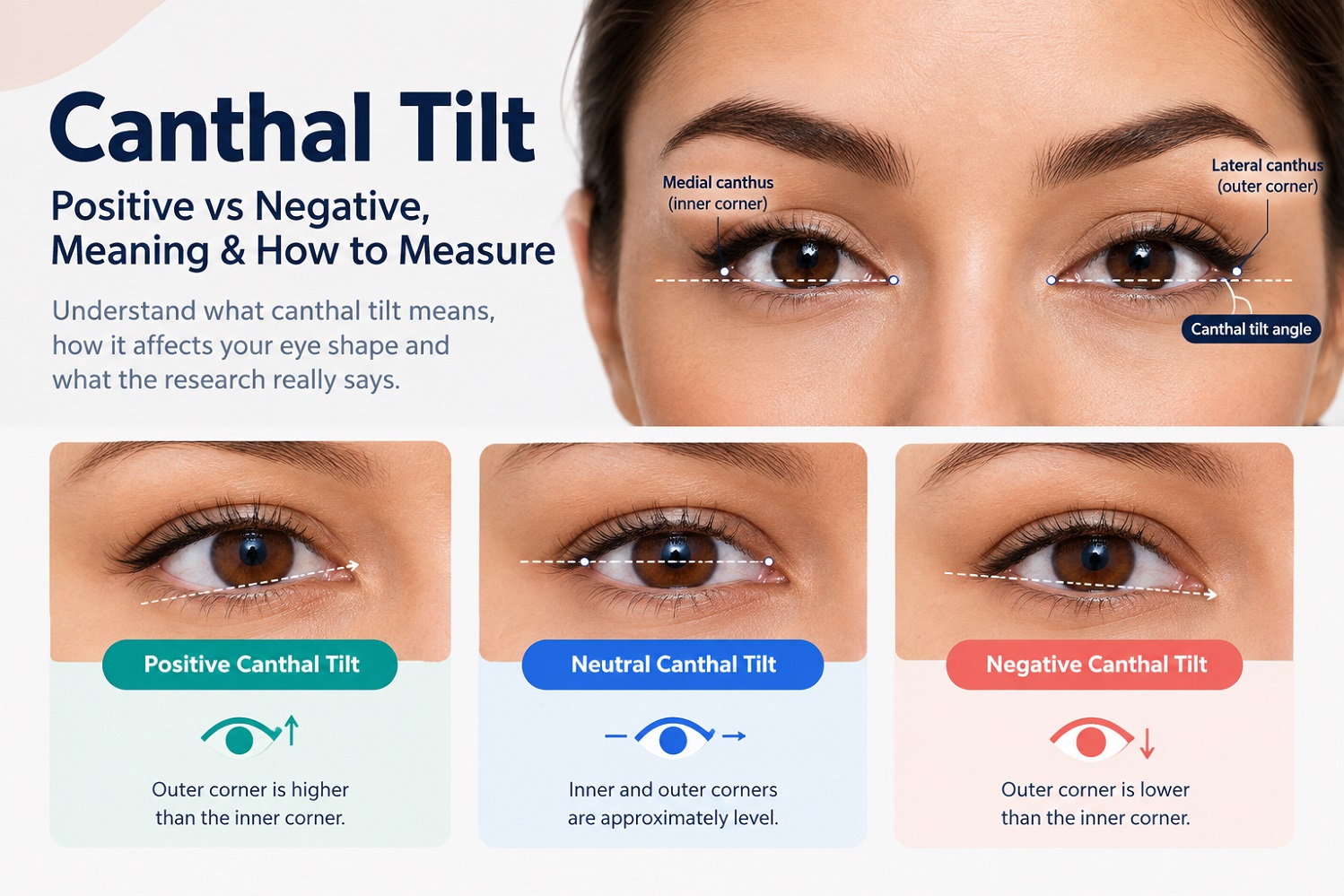
Canthal tilt describes the angle formed by the inner and outer corners of the eye. It is a small facial feature, but it has attracted enormous attention online because people increasingly use it to analyze eye shape, facial aesthetics, and perceived attractiveness.
The basic idea is simple: look at the position of the medial canthus, the inner corner of the eye near the nose, and the lateral canthus, the outer corner near the temple. If the outer corner sits higher, the eye has a positive tilt. If the corners are approximately level, the tilt is neutral. If the outer corner sits lower, it is considered negative.
That sounds straightforward. In practice, it is much more complicated.
The angle can appear different depending on head position, camera perspective, facial expression, eyelid anatomy, brow position, lighting, and even how the photograph is cropped. Research also suggests that people tend to associate certain eye proportions with attractiveness, but that does not mean one particular canthal tilt determines whether someone is attractive.
Understanding that distinction is important, especially now that social-media filters can turn a subtle anatomical measurement into a supposed score for facial beauty.
What Is Canthal Tilt?
Canthal tilt is the inclination of the eye opening between the medial and lateral canthi.
The medial canthus is the inner corner of the eye, while the lateral canthus is the outer corner. A line drawn between these two points can be compared with a horizontal reference line.
The resulting angle is commonly described as the canthal tilt.
In aesthetic medicine, researchers and surgeons may evaluate this feature alongside other characteristics of the periorbital region, including:
- Eyelid position
- Brow shape and height
- Upper-eyelid exposure
- Lower-eyelid position
- Eye fissure shape
- Facial symmetry
- Orbital structure
- Cheek and midface support
- Skin and soft-tissue changes associated with aging
This matters because the eye does not exist visually as an isolated angle. Two people can have a similar measured tilt and still have very different-looking eyes.
Research in aesthetic surgery generally treats canthal tilt as one component of overall facial assessment rather than a standalone measurement of beauty.
Positive, Neutral, and Negative Canthal Tilt
There are three common descriptions.
Positive Canthal Tilt
A positive canthal tilt means the lateral canthus is positioned higher than the medial canthus.
Visually, the eye opening rises slightly toward the temple.
This is sometimes associated with an alert, youthful, or angular appearance. Positive tilt has also been discussed frequently in facial-aesthetics research because several studies have found preferences for upward-sloping eye fissures in particular populations or experimental settings.
That does not mean every face with positive tilt will be perceived as attractive. Facial appearance depends on many interacting features.
Neutral Canthal Tilt
Neutral tilt occurs when the inner and outer corners are approximately level.
There is nothing inherently abnormal about a neutral orientation. Human facial anatomy naturally varies, and small differences can be difficult to identify accurately without controlled photography or measurement.
A person may also appear to have a neutral tilt in one photograph and a slight positive or negative tilt in another because of head position or camera angle.
Negative Canthal Tilt
A negative canthal tilt means the lateral canthus sits lower than the medial canthus.
This creates a downward slope toward the outer corner.
Online discussions sometimes portray negative tilt as a flaw or as evidence of an unattractive eye shape. That interpretation goes far beyond what the research supports.
Negative tilt can occur as normal anatomical variation. It also needs to be distinguished from changes caused by eyelid laxity, aging, trauma, or other medical conditions.
A measurement alone cannot determine whether someone’s eyes are attractive, healthy, youthful, or problematic.
How Is Canthal Tilt Measured?
The simplest visual method is to identify the two canthi and compare the line connecting them with a horizontal reference.
In a clinical or research setting, measurements are generally performed using standardized photographs or anatomical landmarks.
A simplified approach is:
- Take a front-facing photograph.
- Keep the head upright and centered.
- Use a camera positioned approximately at eye level.
- Identify the medial and lateral canthi.
- Draw a line connecting the two points.
- Compare that line with a horizontal reference.
The resulting angle can then be expressed in degrees.
The problem is that even a small change in head position can influence how the eye appears.
Research specifically examining head position found that downward sagittal head tilt can make positive intercanthal tilt appear more pronounced. The study also found that head position influenced other features around the eyes, demonstrating why standardized photography is important when comparing facial images.
Why Your Selfie May Give You the Wrong Impression
A smartphone photograph is not a controlled anatomical measurement.
Several variables can change the apparent angle of your eyes.
Head Position
If you tilt your head downward, the geometry of the face changes in the photograph. Research has demonstrated that this can make positive intercanthal tilt more pronounced.
Camera Height
A camera positioned above or below eye level can alter the apparent shape of the eyelids and eye openings.
Facial Expression
Smiling, squinting, raising the eyebrows, or tightening the lower eyelids can change the visible relationship between the eye corners.
Lens and Perspective
A close selfie taken with a wide-angle smartphone lens can produce different facial proportions from a photograph taken farther away with a longer focal length.
Lighting
Shadows around the eyelids can make one eye corner appear higher or lower than it actually is.
Asymmetry
Most faces are not perfectly symmetrical. One eye may have a slightly different tilt from the other, and that is common.
For these reasons, a social-media filter should not be treated as an accurate clinical measurement.
Does Positive Canthal Tilt Mean You Are More Attractive?
Not automatically.
This is where much of the internet discussion becomes misleading.
There is legitimate research examining the relationship between eye shape and facial attractiveness. One 2007 study found that female faces with an experimentally accentuated medial canthal tilt were preferred over unmodified versions in 93% of forced-choice trials.
That is an interesting finding, but it needs to be interpreted carefully.
The study examined edited images and attractiveness judgments. It does not establish that there is a specific canthal angle that makes a person objectively attractive.
Other research has also suggested that positive eye-fissure inclination can contribute to aesthetic judgments. A literature review in the Aesthetic Surgery Journal notes that positive canthal tilt is generally preferred in some aesthetic literature, while also pointing out that the ideal degree remains debated and can differ among populations.
This distinction is critical:
Aesthetic preference is not the same thing as an anatomical rule.
There is no universal angle that separates attractive faces from unattractive faces.
Canthal Tilt and Facial Aesthetics
Plastic surgeons and oculoplastic specialists do not normally evaluate the eye using one number.
Instead, they look at how multiple structures interact.
For example, an assessment may consider:
- The position of the eyebrow
- Upper-eyelid skin
- Lower-eyelid contour
- Amount of visible sclera
- Eye-opening height
- Canthal position
- Facial symmetry
- Cheek support
- Midface proportions
- Changes associated with aging
Aesthetic research supports this broader approach. Periorbital assessment can involve several variables, including brow position, eyelid ptosis, canthal tilt, skin excess, soft-tissue distribution, and wrinkles.
This is why attempting to judge an entire face based on a single line drawn across the eyes is overly simplistic.
Does Canthal Tilt Change With Age?
The appearance of the eye region can change with age, although this does not mean everyone develops the same type or degree of change.
Changes in skin elasticity, eyelid tissues, brow position, and supporting structures can affect how the eyes look over time.
Some people may develop more downward-looking outer eye corners or increased eyelid hooding as they age. This can contribute to the perception of a more negative tilt.
However, a naturally occurring negative canthal tilt should not automatically be interpreted as an age-related problem.
The distinction between normal anatomy and new structural change is much more important.
If the position of an eyelid or eye corner has changed noticeably over a short period, particularly on one side, that deserves a medical assessment rather than an online attractiveness test.
Can You Change Your Canthal Tilt Naturally?
This question appears frequently because of social-media discussions about “fixing” eye shape.
There is no reliable exercise that can permanently reposition the anatomical canthi.
Eye exercises, facial massage, or repeatedly changing facial expressions should not be expected to structurally move the lateral canthus into a different anatomical position.
Makeup can create a temporary visual effect, however.
For example, eyeliner can be shaped to visually extend the outer corner upward or downward. Lash placement and brow styling can also influence the perceived direction of the eye.
This is very different from physically changing the anatomy.
Makeup Can Create the Appearance of Different Eye Angles
Canthal tilt has become useful in beauty discussions partly because understanding eye geometry can help with makeup placement.
If someone wants the eye to appear more lifted, makeup artists may experiment with:
- An upward-angled eyeliner wing
- Strategic eyeshadow placement
- Lashes that become longer toward the outer corner
- Brow shaping that visually supports the outer eye
- Avoiding a heavy line that pulls visual attention downward
These techniques change perception, not the underlying anatomy.
That distinction makes the trend much more useful. Instead of treating a canthal-tilt filter as a beauty score, it can simply be used as a reference for experimenting with eyeliner or eye makeup.
Can Surgery Change Canthal Tilt?
Yes, certain surgical procedures can alter the position or appearance of the outer eye corner.
Procedures involving the lateral canthus or surrounding tissues can change the shape of the palpebral fissure. Depending on the patient’s anatomy and the procedure, surgeons may consider techniques such as canthoplasty or canthopexy.
However, this is not a casual cosmetic adjustment.
The eye’s lateral support structures play an important functional role. Excessive or poorly planned alteration can produce problems such as eyelid malposition, asymmetry, irritation, difficulty closing the eye, or an unnatural appearance.
That is why an individual considering surgery should be evaluated by an appropriately qualified ophthalmic plastic surgeon, oculoplastic surgeon, or facial plastic surgeon rather than relying on an online filter.
Aesthetic surgery literature also emphasizes that periorbital procedures require evaluation of multiple anatomical factors rather than focusing on a single measurement.
What About Fox-Eye and Cat-Eye Trends?
The popularity of upward-slanting eye makeup has helped push canthal tilt into mainstream beauty conversations.
The so-called fox-eye look typically emphasizes a lifted outer eye and elongated shape through makeup, brow styling, or, in some cases, cosmetic procedures.
The visual effect can resemble a stronger positive tilt, but makeup-created eye shape and anatomical canthal tilt are not the same thing.
A person can create a dramatic upward eye shape with eyeliner without having a naturally positive canthal tilt.
That is an important distinction when looking at photographs online.
Why Canthal Tilt Became a Social-Media Trend
The measurement became especially visible on platforms such as TikTok, where users could apply filters that draw lines across their eyes.
The format is perfect for short-form content:
Look at the camera → apply filter → receive a visual classification.
The problem is that a simple visual classification can easily be interpreted as a judgment.
A filter may tell someone they have positive, neutral, or negative tilt. It cannot determine their overall attractiveness, personality, health, or social appeal.
Glamour’s coverage of the trend similarly highlighted concerns from facial-plastic surgeons about allowing filters and online beauty standards to influence decisions about cosmetic procedures.
Why Social-Media Measurements Can Become Misleading
There is a psychological problem with turning normal anatomy into a pass-or-fail system.
Once people start looking for a particular feature, they can become hyper-focused on it.
Someone who had never thought about their eye corners may suddenly photograph themselves repeatedly, compare their face with influencers, and search for ways to change the feature.
That can create a distorted perception of what is actually a normal anatomical variation.
A better approach is to treat measurements as descriptive information, not as a score.
Your face contains dozens of interacting proportions. A single angle cannot capture the whole picture.
Can One Eye Have a Different Canthal Tilt?
Yes.
Facial asymmetry is extremely common.
One eye may appear slightly more elevated than the other because of differences in:
- Eyelid anatomy
- Brow position
- Orbital structure
- Soft-tissue distribution
- Facial muscle activity
- Previous injury or surgery
- Natural developmental asymmetry
Small differences are often visible only when photographs are compared carefully.
If asymmetry is longstanding and stable, it may simply represent your normal anatomy.
A newly developing or rapidly worsening asymmetry is different and should be discussed with a medical professional.
Canthal Tilt vs. Eye Shape
These terms are related but should not be confused.
Canthal tilt describes the inclination between the eye corners.
Eye shape describes the broader contour and proportions of the eye opening.
Two people can have the same canthal tilt while having very different eye shapes because the width, height, eyelid exposure, crease position, and surrounding structures can differ.
This is one reason why statements such as “positive canthal tilt equals almond eyes” are inaccurate.
The angle is one characteristic, not a complete description of the eye.
Is Negative Canthal Tilt Bad?
No.
Negative canthal tilt is not automatically a medical problem or an indicator of poor appearance.
Aesthetic research may identify preferences for particular eye orientations in specific experimental populations, but that does not make other orientations abnormal.
Even within aesthetic medicine, there is debate over the ideal degree of tilt, and preferred measurements can vary across populations.
The internet often turns a continuous anatomical spectrum into three categories:
positive = good
neutral = average
negative = bad
Human anatomy does not work that way.
When Should You Actually See a Doctor?
Most people do not need medical attention simply because an online filter identifies a negative or uneven canthal tilt.
Medical evaluation becomes more relevant when there is a noticeable change in the position or function of the eyelid.
Consider seeing an eye-care professional if you experience:
- A sudden change in eyelid position
- New or rapidly increasing asymmetry
- Difficulty closing one eye
- Persistent eye irritation or dryness
- Changes after trauma
- A drooping eyelid
- Double vision or changes in vision
- Significant discomfort around the eye
- Changes following previous eyelid or facial surgery
Those symptoms are different from simply having a naturally positive, neutral, or negative eye angle.
How to Take a Better Photo for Canthal Tilt Comparison
If you are simply curious about your eye geometry, use consistent photography rather than comparing random selfies.
Try this:
- Face the camera directly.
- Keep your head level.
- Look straight ahead rather than up or down.
- Keep your facial expression relaxed.
- Use even lighting.
- Keep the camera at approximately eye level.
- Avoid extreme wide-angle close-ups.
- Take several photographs under the same conditions.
- Compare both eyes rather than judging one photograph.
- Treat the result as an approximation rather than a clinical measurement.
Consistency matters because head position alone can change the apparent relationship between the eye corners.
Canthal Tilt and Beauty: What the Evidence Actually Supports
The most reasonable interpretation of the available research is nuanced.
Studies suggest that eye orientation can influence aesthetic judgments. Positive inclination has been preferred in some experimental and population-specific research.
But the evidence does not support the idea that:
- One exact angle is universally attractive.
- Negative tilt makes someone unattractive.
- A filter can accurately score facial attractiveness.
- Everyone should try to achieve positive tilt.
- Exercises can permanently reposition the canthi.
- Surgery is justified simply because an app labels someone’s tilt as negative.
Facial attractiveness is multidimensional.
The surrounding eyes, eyebrows, nose, cheeks, lips, facial proportions, expression, skin, hairstyle, and countless other visual factors interact with one another.
There is also a cultural component to aesthetic preference, which makes universal beauty formulas particularly unreliable.
Frequently Asked Questions About Canthal Tilt
What is a positive canthal tilt?
A positive canthal tilt means the outer corner of the eye is positioned higher than the inner corner. It creates an upward inclination toward the temple.
What is a negative canthal tilt?
A negative canthal tilt means the outer corner sits lower than the inner corner, creating a downward inclination.
Is neutral canthal tilt normal?
Yes. A roughly level relationship between the eye corners is a normal anatomical variation.
Which canthal tilt is most attractive?
There is no universally accepted ideal. Some facial-aesthetics research reports a preference for positive inclination, but the preferred degree varies and attractiveness cannot be reduced to one measurement.
Does canthal tilt determine attractiveness?
No. It can contribute to the visual impression of the eyes, but it cannot determine overall attractiveness.
Can exercises change canthal tilt?
There is no established exercise that permanently changes the anatomical position of the canthi.
Can makeup change how canthal tilt looks?
Yes. Eyeliner, lashes, eyeshadow, and eyebrow styling can create the visual impression of a more lifted or downward eye shape.
Does canthal tilt change with age?
The appearance of the eye region can change with aging because of changes in skin, eyelids, brows, and supporting tissues. A new or significant change should be assessed medically rather than assumed to be a normal cosmetic variation.
Should I worry if a TikTok filter says I have negative canthal tilt?
No. A social-media filter is not a medical diagnosis or an objective attractiveness score. It is better viewed as a visual experiment.
Author

