





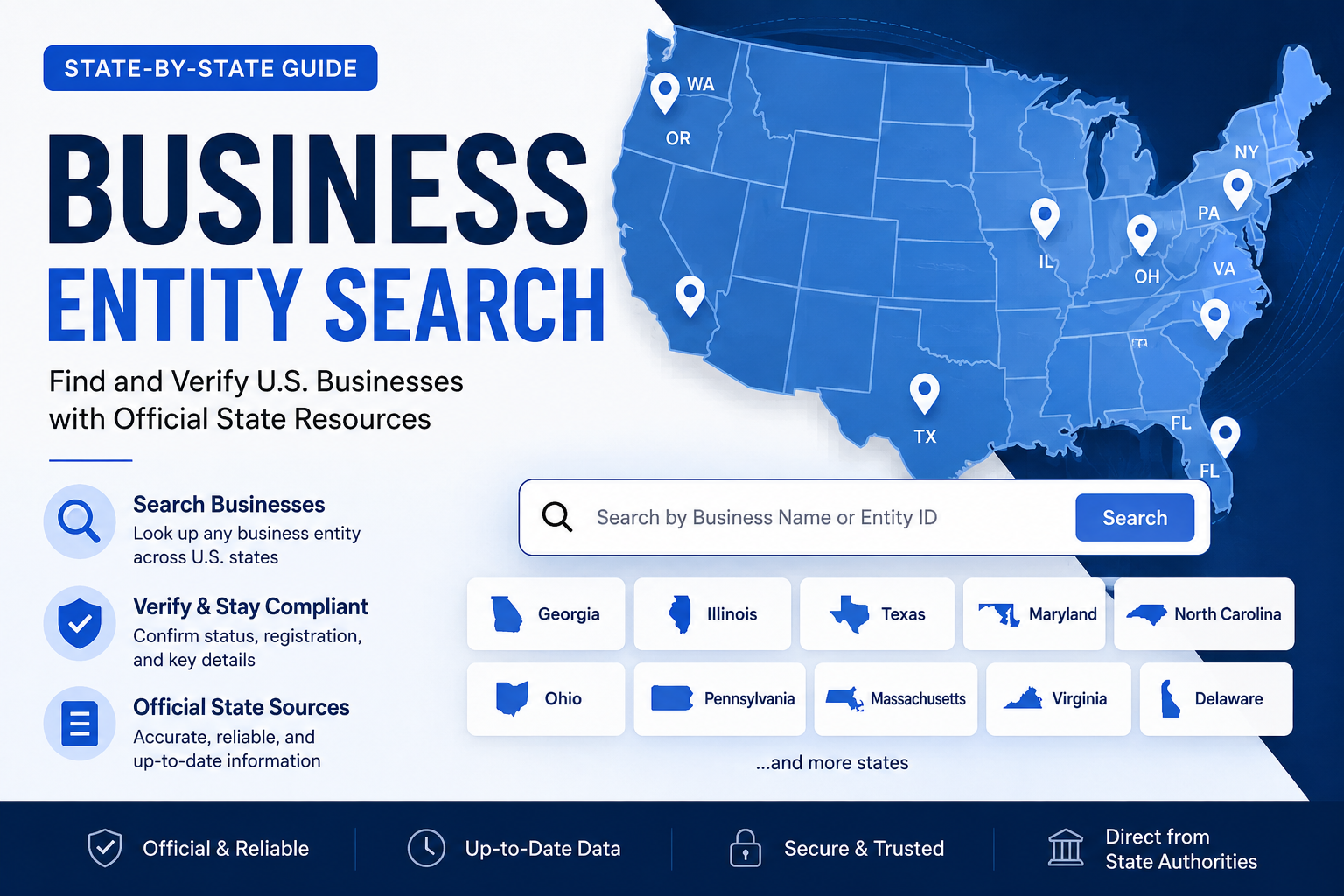
Business Search: How to Find, Research, and Verify Businesses Across the USA
Finding a business is easy. Finding the right business—and knowing whether the information you find is accurate—is where the real work begins.
A simple search can return dozens of results: company websites, Google listings, directories, social profiles, review pages, and businesses with nearly identical names. That is useful when you only need a phone number. It is not enough when you are hiring a contractor, choosing a supplier, signing a contract, checking an LLC, researching a competitor, or sending a large payment to a company you have never worked with before.
A proper business search helps answer more important questions:
- Does this business actually exist?
- Am I looking at the correct company?
- What does the business do?
- Where does it operate?
- Is the contact information current?
- Does the company’s public information match its legal identity?
- Are there warning signs I should investigate before moving forward?
For example, imagine you are about to sign a contract with a company called ABC Commercial Services. A quick online search finds a professional website and several reviews. That is a useful starting point, but you may still need to determine whether the business name on the contract matches the correct legal entity, whether the company operates from the address listed, and whether you are dealing with the same organization you researched online.
That difference matters.
This guide explains how to search for businesses across the United States, how to research a company properly, how business entity searches differ from ordinary local searches, and how to verify important information before making a decision.
What Is a Business Search?
A business search is the process of finding and evaluating information about a company, organization, local business, or registered business entity.
The purpose depends on what you need.
Someone looking for a restaurant in Chicago has a very different goal from an entrepreneur checking whether an Illinois LLC name is already in use. A purchasing manager researching a supplier in Texas needs different information from a customer trying to find a reliable roofing company.
Business searches commonly fall into several categories:
- Finding a local business
- Searching for a company by name
- Looking up a specific business
- Researching an LLC or corporation
- Checking publicly available registration information
- Comparing service providers
- Researching suppliers and business partners
- Investigating competitors
- Checking business names before starting a company
- Performing basic business verification
The important point is simple: the way you search should match the reason you are searching.
If you need a plumber near your home, a local search is appropriate. If you are about to enter a business agreement, you may need a more structured process involving the company’s website, public business records, contact details, reputation, licenses, and other relevant information.
Why Business Search Matters
Business decisions can involve money, contracts, services, products, and long-term relationships. Making a decision based on incomplete information creates unnecessary risk.
A structured business search does not guarantee that a company will be the right choice. What it does is reduce avoidable uncertainty.
Before hiring a local contractor, for example, you might check:
- The official website
- Services offered
- Current address and contact information
- Customer feedback
- Years of experience
- Relevant licenses or credentials
- Service area
- Examples of previous work
Before entering a major B2B agreement, your research may go further. You may need to understand:
- The company’s legal identity
- Available registration information
- Its business history
- Industry reputation
- Current operations
- References or case studies
- Who is authorized to represent the company
- Contract terms
The higher the value or risk of the transaction, the more carefully you should verify what you find.
There is a major difference between spending $100 with a local business and committing thousands of dollars to a supplier or business partner. Your research process should reflect that difference.
The Main Types of Business Searches
Not every business-related search has the same intent. Understanding the differences helps you search more efficiently.
Local Business Search
A local business search is usually about discovering companies that provide a particular product or service in a specific area.
Examples include:
- Plumbers in Dallas
- Restaurants in Chicago
- Accountants in Boston
- HVAC companies in Atlanta
- Marketing agencies in Miami
The person searching usually wants to compare options and choose a provider.
Important factors may include location, availability, services, pricing, reviews, and experience.
Business Name Search
A business name search is used when you already know the name of a company.
For example:
ABC Manufacturing LLC
You may be trying to find:
- The official website
- Contact information
- Business location
- Services
- Public information
- Reviews
- Registration details
Using the exact company name, along with a city or state when necessary, can help reduce confusion when several businesses have similar names.
Business Entity Search
A business entity search focuses more on the legal or registered identity of an organization.
This may involve researching:
- LLCs
- Corporations
- Partnerships
- Limited partnerships
- Nonprofit organizations
- Other registered business entities
This type of search becomes particularly important when the company’s public-facing brand differs from its legal name.
For example, a company may advertise under one brand name while contracts, invoices, or registration records use a different LLC name. Those details should be understood before an important transaction.
Business Lookup
A business lookup usually means the searcher already has a specific company in mind.
Examples include:
- Texas business lookup
- Ohio business lookup
- Company name + state
The goal is less about discovering new businesses and more about researching or confirming information about a particular organization.
Competitor and Supplier Research
Business search is also useful for professionals and entrepreneurs.
You may search for businesses to:
- Identify competitors
- Find manufacturers
- Research wholesalers
- Locate distributors
- Compare service providers
- Find technology partners
- Explore potential partnerships
- Identify gaps in a local market
In these cases, the search often goes beyond finding a company name. You are trying to understand the market and make a better business decision.
Business Search vs. Business Entity Search
These two terms are closely related, but they do not always mean the same thing.
| Search Type | Main Purpose | Example |
| Local business search | Find businesses that provide a service | Restaurants in Austin |
| Business name search | Find information about a known company | ABC Construction Texas |
| Business search | Broadly find or research companies | Georgia business search |
| Business lookup | Investigate a particular company | Texas business lookup |
| Business entity search | Research a legal or registered organization | Texas business entity search |
| LLC search | Research an LLC or similar entity | Illinois LLC search |
Here is the practical difference.
If you search for “best restaurants in Austin,” you are trying to discover businesses.
If you search for “Texas business entity search,” you are more likely trying to research a particular registered organization or legal business identity.
Both are business searches, but the information you need is different.
One of the most common mistakes is treating a business listing as proof of a company’s legal identity. A local listing can help you find a business. It does not automatically answer every question about registration, ownership, licensing, or the entity named in a contract.
How to Search for a Business Effectively
A strong business search starts before you type anything into a search engine.
First, ask yourself:
What exactly am I trying to verify or find?
Once you know the answer, use the following process.
Step 1: Start With the Exact Business Name
If you know the company’s name, begin with the exact name.
Then add a location if necessary:
Business Name + City
or:
Business Name + State
For example:
ABC Construction Texas
This can help distinguish between businesses with similar or identical names.
Be careful with spelling. A small difference can point you toward a completely different company.
Step 2: Check the Official Website
The company’s official website can provide useful information about:
- Products and services
- Company background
- Locations
- Contact details
- Leadership
- Industry experience
- Case studies
- Customer information
A professional website can be helpful, but it should not be your only source of information.
Websites are created and controlled by the business itself. For important decisions, compare the information you find with other relevant sources.
Step 3: Confirm the Location and Contact Details
Check whether the information appears current.
Look for:
- Physical address
- Phone number
- Email address
- Business hours
- Service area
- Website domain
Businesses can move, change ownership, update phone numbers, or stop offering certain services.
If you find conflicting information, do not automatically assume fraud. Sometimes business directories simply contain old data. Still, a conflict is worth investigating before making an important decision.
Step 4: Review Reputation and Customer Feedback
Reviews can provide useful information when you look for patterns.
Do not focus entirely on one extremely positive or negative comment.
Instead, ask:
- Do customers repeatedly mention poor communication?
- Are billing issues mentioned by several people?
- Is delayed service a recurring complaint?
- Are there repeated concerns about product quality?
- Does the business appear to resolve problems professionally?
One negative review does not automatically make a business unreliable. Every established company can have dissatisfied customers.
Patterns are usually more useful than isolated opinions.
Step 5: Identify the Correct Business Entity
This step is especially important when you are:
- Signing a contract
- Hiring a supplier
- Sending a large payment
- Entering a partnership
- Conducting professional due diligence
The business name you see on a website may not be the exact legal entity name.
Compare the relevant names carefully.
For example, a company may market itself under ABC Digital Solutions, while the legal entity connected with contracts is ABC Holdings LLC.
That does not automatically indicate a problem. Businesses often use brands, trade names, or different legal structures. The important thing is knowing exactly who you are dealing with.
Step 6: Compare Multiple Sources
Do not rely on one webpage when the decision matters.
Compare relevant information from:
- Official company websites
- Public business information
- State-level business records where applicable
- Customer reviews
- Professional directories
- Industry organizations
- Relevant licensing authorities
If important details conflict, pause and investigate.
A business search is strongest when separate sources point toward the same basic facts.
A Practical 7-Step Business Verification Checklist
Finding a company is only the first part of the process.
Before spending significant money or entering an agreement, work through this checklist.
1. Confirm the Exact Business Name
Make sure you have the correct spelling and location.
Similar names are common, particularly when businesses operate in different states.
2. Find the Official Website
Check what the company says about:
- Services
- Locations
- Experience
- Contact information
- Leadership
- Business operations
3. Match the Contact Information
Compare the address, phone number, website, and other relevant details across trustworthy sources.
4. Understand the Legal Identity
If the transaction requires it, determine which legal entity you are actually dealing with.
Pay close attention to the name used on:
- Contracts
- Invoices
- Payment instructions
- Official documents
5. Review Public Reputation
Look for patterns across reviews, industry discussions, references, and other relevant sources.
6. Verify Relevant Credentials
Depending on the industry, this may include:
- Professional licenses
- Certifications
- Insurance
- Industry memberships
- Other credentials relevant to the work being performed
7. Match the Research to the Risk
A small purchase may require only basic research.
A major contract may require much more.
For high-value agreements, investments, acquisitions, or legal transactions, professional due diligence and qualified legal or financial advice may be appropriate.
Business Search Red Flags Worth Investigating
Not every inconsistency means a business is illegitimate. Companies change addresses, rebrand, and operate under different names.
Still, certain situations deserve closer attention.
Watch for:
- The business name differs significantly between the website and contract
- Multiple sources show conflicting contact information
- You cannot identify the company behind the website
- The company pressures you to make an immediate payment
- Repeated complaints describe the same serious problem
- Important credentials cannot be independently verified
- The business uses vague descriptions but provides little information about what it actually does
- The company appears to have multiple confusingly similar identities
- Payment instructions do not match the company you researched
- Contact information changes unexpectedly during a transaction
The right response is not always to reject the company immediately.
The right response is to ask better questions and verify the details before moving forward.
Business Search Across the United States
The United States has a large and diverse business environment. Each state has its own economy and business registration systems, which is why users often search for state-specific information.
The following terms can have slightly different purposes depending on the user’s goal:
- Business search
- Business entity search
- Entity search
- LLC search
- Business lookup
- Secretary of State business search
A good pillar page should explain the broad process. Detailed state guides can then provide more specific information for people researching a particular location.
Georgia Business Search
A Georgia business search may involve finding local companies, researching an organization, or checking information about a specific business.
Georgia has significant activity in industries such as:
- Logistics
- Technology
- Film and entertainment
- Manufacturing
- Healthcare
- Financial services
Atlanta is a major business center, while Savannah, Augusta, Columbus, and other areas also support diverse local economies.
Georgia Business Entity Search
A general search might help you find a company’s website and customer reviews.
An entity-focused search is more useful when your question is different:
Which registered organization am I dealing with?
This distinction can matter when businesses have similar names or when a public brand name differs from the legal entity.
Illinois Business Search
Illinois business searches can involve local business discovery, company research, entity searches, and LLC research.
Major industries include:
- Finance
- Manufacturing
- Transportation
- Healthcare
- Technology
- Professional services
Chicago is one of the country’s largest business centers, but businesses operate throughout Illinois.
Related searches may include:
- Illinois business entity search
- Illinois entity search
- Illinois LLC search
- IL Secretary of State business search
These phrases overlap considerably. Rather than treating every variation as a completely separate topic, the important question is what the searcher needs to know about the company.
Illinois LLC Search
An entrepreneur considering a new business name may search for existing entities with similar names.
A researcher may use the same type of search for a different reason: to distinguish between companies with similar branding.
The keyword may be similar, but the practical purpose can be very different.
Maryland Business Entity Search
A Maryland business entity search can be useful when researching a company connected with the state.
Maryland has strong activity in:
- Biotechnology
- Healthcare
- Cybersecurity
- Government contracting
- Technology
- Financial services
Imagine a company receives a proposal from a vendor based in Baltimore.
Before moving forward, it may want to:
- Confirm the company’s legal name.
- Review available business information.
- Visit the official website.
- Check current contact details.
- Verify relevant professional credentials.
- Request references when appropriate.
An entity search can be one part of that larger research process.
Texas Business Search and Business Entity Search
Texas has one of the largest and most diverse business markets in the United States.
Major sectors include:
- Energy
- Technology
- Healthcare
- Manufacturing
- Real estate
- Finance
Houston, Dallas, Austin, San Antonio, and Fort Worth are major business centers.
A Texas business search may be broad and exploratory.
A Texas business lookup usually suggests that the searcher already has a particular company in mind.
A Texas business entity search is generally more focused on researching the identity of a registered organization.
If you are considering a company before signing a contract, hiring it, sending payment, or entering a partnership, do not stop at the first search result. Compare the relevant information carefully.
North Carolina Business Search
North Carolina has a growing and diverse economy supported by industries such as:
- Banking
- Technology
- Biotechnology
- Manufacturing
- Research
- Healthcare
Charlotte and Raleigh are particularly important business centers.
Common search variations include:
- North Carolina business search
- North Carolina business entity search
- NC Secretary of State business search
- NC SOS business search
These searches generally relate to finding or researching businesses connected with North Carolina.
The abbreviation changes. The central question often does not:
What information do I need about this business, and where can I verify it?
Ohio Business Search and Business Lookup
Ohio supports major activity in:
- Manufacturing
- Healthcare
- Finance
- Logistics
- Technology
- Retail
Columbus, Cleveland, and Cincinnati are important business markets.
An Ohio business search can be broad.
An Ohio business lookup usually involves researching a particular company.
For example, if your company receives a proposal from an Ohio supplier, your process may include:
- Searching for the supplier online.
- Reviewing the official website.
- Confirming contact details.
- Researching its reputation.
- Identifying the correct business entity when relevant.
That is a better approach than relying on one search result.
Tennessee Secretary of State Business Search
Tennessee has significant business activity in:
- Healthcare
- Logistics
- Manufacturing
- Tourism
- Music and entertainment
Nashville, Memphis, Knoxville, and Chattanooga all have active business communities.
A Tennessee business search may help someone find a company. A state-level entity search is more relevant when the goal is to research a specific organization connected with Tennessee.
Before entering a professional relationship, make sure the information you find answers the question you actually have.
Finding a business and verifying a business are not the same task.
Pennsylvania Business Search
Pennsylvania supports major industries including:
- Healthcare
- Manufacturing
- Technology
- Energy
- Finance
- Education
Philadelphia and Pittsburgh are among the state’s largest business markets.
Related searches include:
- Pennsylvania business search
- Pennsylvania business entity search
- PA business entity search
- PA SOS business entity search
- PA SOS business search
These phrases are closely related, but they may indicate different levels of research.
A broad search can help you discover a business.
An entity-focused search is more useful when you need to identify the correct legal organization.
For SEO and for readers, these terms should be covered naturally. Repeating every variation excessively does not make the information more useful.
Massachusetts Business Search
Massachusetts has strong business activity in:
- Technology
- Healthcare
- Biotechnology
- Finance
- Education
Boston is one of the country’s major centers for innovation and business development.
A Massachusetts business search may help you discover companies, while an entity search may help distinguish between organizations with similar names.
That can be particularly useful when a company name is common or when similar businesses operate in different industries.
Always check the location and other identifying information before assuming you have found the correct organization.
Oregon Business Search
Oregon businesses operate across industries including:
- Technology
- Manufacturing
- Agriculture
- Outdoor products
- Food and beverage
- Professional services
Portland is one of the state’s major business centers.
Related searches may include:
- Oregon business entity search
- Oregon Secretary of State business search
- OR SOS business search
These are variations of a similar state-level research intent.
The useful next step is not simply finding another page containing the keyword. It is determining what information you need about the company and checking the most appropriate sources.
Indiana Business Search
Indiana has strong activity in:
- Manufacturing
- Automotive
- Healthcare
- Agriculture
- Logistics
A company looking for a manufacturing supplier in Indianapolis, for example, might first identify potential businesses and then conduct deeper research on the most promising options.
The first search helps create a list.
The research that follows helps determine which companies are worth contacting.
Michigan Business Search
Michigan remains strongly associated with automotive and advanced manufacturing, although its business environment includes much more.
Important sectors include:
- Automotive
- Manufacturing
- Technology
- Healthcare
- Logistics
A Michigan business search can help companies identify potential suppliers, service providers, partners, and competitors.
As with any supplier or partner search, do not confuse visibility with verification. A company appearing prominently online does not eliminate the need to research the business itself.
Virginia Business Search
Virginia has significant activity in:
- Technology
- Cybersecurity
- Government contracting
- Defense
- Financial services
Related searches include:
- Virginia business entity search
- Virginia Secretary of State business search
A business search can help identify companies connected with Virginia.
An entity-focused search can become important when you need to understand the legal identity of a company before entering into a contract or other professional relationship.
Delaware Business Search
Delaware is especially important in business research because many companies choose to incorporate there even when their main offices operate elsewhere.
That means a company’s:
- State of incorporation
- Headquarters
- Main office
- Operating locations
may not all be the same.
For example, a company could be incorporated in Delaware, headquartered in California, and employ people across several states.
This is why business research should consider both legal registration information and the company’s actual operating presence.
A Delaware SOS business search can be relevant when researching a company incorporated or registered in Delaware, but the information should be viewed as one part of the larger picture.
Kentucky Business Entity Search
Kentucky has business activity in areas such as:
- Manufacturing
- Automotive production
- Logistics
- Agriculture
- Healthcare
A business entity search may be useful when:
- Checking a potential business name
- Researching a company
- Distinguishing between similarly named organizations
- Conducting preliminary due diligence
Entrepreneurs should remember that finding a similar name in a search is not the same as receiving legal advice about whether a name is available for use. Formal naming and registration decisions may require checking the applicable rules and procedures.
Louisiana Business Entity Search
Louisiana has important industries including:
- Energy
- Shipping
- Tourism
- Agriculture
- Manufacturing
Business registration information can be useful when researching a company.
It should not be treated as a complete trust assessment.
For important decisions, also consider:
- Current business operations
- Company reputation
- Professional licenses
- References
- Relevant credentials
- Written agreements
A business can exist as a registered entity and still require further research before you decide to work with it.
Missouri Business Entity Search
Missouri has significant activity in:
- Manufacturing
- Agriculture
- Healthcare
- Transportation
- Finance
Kansas City and St. Louis are major business centers.
An entrepreneur planning a new business may research existing entities with similar names before developing a brand.
A company researching a potential partner may use the same type of search to identify similarly named organizations.
Again, the search tool may be similar. The purpose behind the search determines what you do with the information.
How to Verify a Business Before Working With It
Verification should be treated as a process, not a single search.
Check Multiple Sources
Do not rely entirely on one website.
Compare relevant information from:
- Official company websites
- Public business information
- Customer reviews
- Professional directories
- Industry organizations
- Licensing authorities when applicable
When information conflicts, investigate the reason.
Sometimes the explanation is harmless. A company may have moved or changed its phone number.
Sometimes the difference matters.
The goal is to understand which information is current and accurate.
Confirm the Business Name
Businesses may operate under:
- A brand name
- A trade name
- An LLC name
- A corporate name
Make sure you understand which name belongs to the organization you are dealing with.
This is particularly important when signing contracts or making payments.
Check Current Contact Details
Verify relevant information such as:
- Address
- Phone number
- Website
Outdated information is not automatic proof that a business is unreliable.
It is simply a reason to confirm the details before proceeding.
Review the Company’s Online Presence
Look for clear information about:
- Services
- Location
- Team or leadership
- Experience
- Contact methods
A limited online presence does not automatically mean a company is untrustworthy. Smaller or traditional businesses may have minimal websites.
What matters is whether the available information makes sense and whether important claims can be independently supported when necessary.
Common Business Search Mistakes
Even experienced people can make poor decisions when they search too quickly.
Searching Too Broadly
A search such as:
Best business USA
is too vague.
A more useful search might be:
Commercial cleaning companies in Chicago
Specific searches usually produce more relevant results.
Assuming the First Result Is the Best Choice
Search rankings do not automatically determine which business is right for you.
The first result may be useful. It may also simply be the most visible.
Compare multiple options.
Ignoring Similar Business Names
Businesses can have similar names, especially across different states.
Always verify:
- The correct location
- The correct website
- The correct business identity
Do not assume that a name match alone proves you have found the right company.
Relying Only on Reviews
Reviews are useful, but they should not be the only factor.
Look for patterns and combine customer feedback with independent research.
Ignoring the Difference Between a Brand and a Legal Entity
A company may market itself under one name while its legal business entity uses another.
For professional transactions, understanding that difference can prevent confusion later.
Business Search for Entrepreneurs
Business research is not only useful for customers.
Entrepreneurs can use business searches to:
- Study competitors
- Find suppliers
- Research potential partners
- Explore business names
- Identify market opportunities
- Analyze local competition
Example: Finding a Market Gap
Imagine you are researching digital marketing agencies in a growing city.
You find dozens of companies.
At first, that may suggest the market is already crowded.
Then you read customer feedback and notice a repeated complaint: clients often say agencies are difficult to reach and provide unclear reporting.
That creates a different insight.
The opportunity may not be to build another agency that offers the same vague list of services. The opportunity could be to compete on something customers clearly value:
- Faster communication
- Transparent reporting
- Clear pricing
- Better account management
The best competitor research is not about copying competitors.
It is about understanding what customers still believe is missing.
Business Search for Supplier Research
Companies often search for:
- Manufacturers
- Wholesalers
- Distributors
- Service providers
- Technology partners
A supplier search should go beyond typing a product into a search engine and choosing the first company you find.
Consider:
- Company background
- Industry experience
- Products or services offered
- Reputation
- Communication quality
- Business identity
- Relevant credentials
- Contract terms
For high-value agreements, additional professional due diligence may be appropriate.
A supplier with an impressive website may still be the wrong fit for your company.
The goal is to find a supplier that can meet your actual requirements.
Business Search and Local SEO
For business owners, being easy to find matters.
When a potential customer searches for your company or services, the information they see should be clear and consistent.
Important details include:
- Business name
- Address
- Phone number
- Website
- Business category
- Operating hours
- Services
Consistency matters because conflicting information creates confusion.
If customers find one address on your website and another address elsewhere, they may wonder which information is correct.
Clear information also helps potential customers understand whether your business is relevant to their needs.
How Businesses Can Improve Their Search Visibility
Businesses should make it easy for people to understand what they actually do.
Avoid vague descriptions such as:
“We provide innovative solutions for modern businesses.”
That statement sounds polished, but it tells a potential customer almost nothing.
A more useful description would be:
“We provide bookkeeping and payroll services for small businesses in Austin, Texas.”
Specific information helps users understand:
- What you offer
- Who you serve
- Where you operate
- Whether your business is relevant to their needs
Publish Helpful Industry Content
Businesses can build trust by answering genuine customer questions.
An accounting company might publish content about:
- Small business tax planning
- Payroll processes
- Cash flow management
A manufacturing company might publish:
- Material selection guides
- Production process information
- Supply chain insights
The standard should be usefulness.
Publishing pages simply to increase the number of URLs rarely creates lasting value.
Create Useful Location Pages
Businesses serving multiple locations may create location-specific pages.
Examples include:
- SEO Services in Dallas
- Digital Marketing Services in Houston
- Business Consulting in Austin
Each page should provide useful information about that location or service.
Avoid creating hundreds of nearly identical pages where only the city name changes.
Strong location pages can include:
- Services available
- Areas served
- Local experience
- Relevant case studies
- Contact information
The Future of Business Search
Business search is increasingly about relevance, accuracy, and trust.
People do not simply want a list of company names.
They want answers to practical questions:
- Is this the right business?
- Does this company offer what I need?
- Is the information current?
- Can I verify the organization?
- How does this company compare with alternatives?
For businesses, visibility requires more than owning a website.
People need to be able to understand who you are and what you do.
That means providing:
- Accurate business information
- Clear service descriptions
- Useful content
- Reliable contact details
- Consistent branding
- Genuine customer service
The easier a business is to understand and verify, the easier it is for potential customers and partners to make informed decisions.
Frequently Asked Questions About Business Search
How do I search for a business by name?
Start with the exact business name. If the name is common, add the city or state.
You can then compare the official website, contact information, public business information, and other relevant sources to confirm you have found the correct company.
What is the difference between a business search and a business entity search?
A general business search can help you find or research companies.
A business entity search is more focused on researching the legal or registered identity of an organization.
Why should I verify a business before paying it?
Verification can help reduce the risk of dealing with the wrong company or relying on outdated information.
The level of research should depend on the value and importance of the transaction.
Are online reviews enough to verify a business?
No.
Reviews can provide useful information, especially when you identify repeated patterns, but they should be combined with other relevant research.
What should I do if a company’s business name and legal name are different?
Do not automatically assume there is a problem.
Businesses may operate under brands or trade names.
For important transactions, make sure you understand which legal entity is named in the relevant contract, invoice, or agreement.
What information should I check before hiring a supplier?
Consider the company’s background, products or services, industry experience, reputation, communication, business identity, relevant credentials, and contract terms.
Business Search: Find the Right Information Before Making a Decision
A smart business search is about more than finding a company name.
It is about understanding:
- Who the business is
- What it offers
- Where it operates
- Whether you have found the correct organization
- Whether the information appears current
- What additional verification is appropriate for your decision
Whether you are conducting a Georgia business search, researching an Illinois business entity search, checking a Texas business lookup, performing a Pennsylvania business search, or looking for information through an Oregon Secretary of State business search, the same principle applies:
Start with the right question. Use reliable sources. Compare important information. Verify the details that matter before making a major decision.
For consumers, this can lead to better choices.
For entrepreneurs, business search can reveal competitors, suppliers, and market opportunities.
For businesses, being easy to find and easy to understand can directly influence customer trust.
As your website grows, this page can serve as the central Business Search resource connecting readers to detailed state-level guides across the United States.
The strongest long-term content strategy is to keep this pillar focused on the complete business research process, then support it with useful, in-depth cluster pages for individual states and search topics.
Every page should answer a real question.
Every internal link should help the reader take the next logical step.
And the content should always be written for the person performing the search—not simply for the keyword they typed into Google.
Author

