





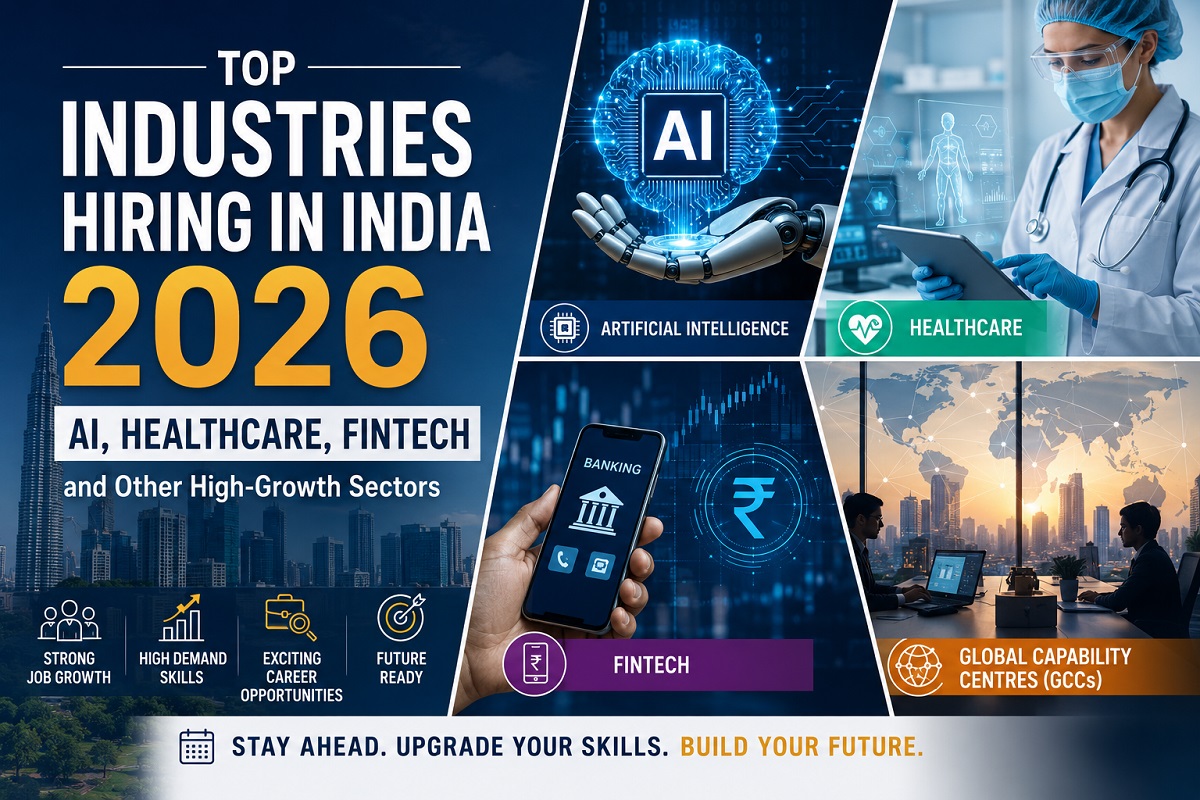
Top Industries Hiring in India 2026: AI, Healthcare, Fintech and the Careers to Watch
India’s job market in 2026 is not simply growing—it is changing direction. Hiring is becoming more specialised, artificial intelligence is influencing roles across traditional industries, and companies are increasingly looking for people who combine domain knowledge with digital skills.
The top industries hiring in India 2026 AI healthcare fintech are not limited to software companies. Healthcare, banking, insurance, fintech, manufacturing, e-commerce, telecommunications, renewable energy, pharmaceuticals, and Global Capability Centres (GCCs) are all creating opportunities, although the type of talent they want is changing.
Recent hiring data makes the shift clear. Naukri reported 6% year-on-year growth in white-collar hiring in June 2026, while AI/ML hiring grew 25%. Insurance hiring increased 16%, FMCG 7%, telecom 6%, real estate 5%, and pharma/biotech and BPO/ITES 4% each.
At the same time, July 2026 job postings increased 1.2% month over month and were 8.3% higher than the same month a year earlier, with healthcare recording the strongest gains in the latest Indeed data.
For students, fresh graduates, experienced professionals, and people considering a career change, the important question is no longer simply “Which industry has jobs?”
It is:
“Which industries are hiring, what skills are they buying, and how can I become useful to those employers?”
India’s Hiring Market in 2026: What Has Changed?
The biggest mistake a job seeker can make in 2026 is treating “technology” and “IT” as the same thing.
Traditional IT services hiring has become more selective, while specialised technology roles continue to grow. Reuters reported that AI-related hiring in India’s IT sector increased 16% year over year in June 2026 even as overall IT recruitment declined 3%. AI and machine-learning job listings also increased across multiple non-IT sectors.
This tells us something important.
AI is increasingly becoming a cross-industry skill.
A healthcare company may need an AI engineer. A bank may need a machine-learning specialist for fraud detection. An insurer may need data scientists. A manufacturer may need computer-vision engineers. A retailer may need recommendation-system specialists.
The industry provides the business problem. Technology provides part of the solution.
That is why candidates who understand both sides of the equation can stand out.
1. Artificial Intelligence, Machine Learning and Data
AI is one of the strongest hiring themes in India in 2026, but the opportunity is broader than the title “AI Engineer.”
Naukri reported 25% year-on-year growth in AI/ML roles in June, following strong growth earlier in the year. In March, AI/ML hiring grew 37% year over year, while full-year AI/ML hiring growth for FY2026 was reported at 45%.
Roles employers are looking for
Depending on the company, opportunities can include:
- AI engineer
- Machine-learning engineer
- Data scientist
- Data analyst
- Generative AI specialist
- MLOps engineer
- Data engineer
- AI product manager
- Computer-vision engineer
- Natural-language-processing specialist
- AI security specialist
- Automation engineer
There is also growing demand for professionals who can apply AI without necessarily building foundation models from scratch.
For example, a marketing professional who understands customer analytics and AI automation may be more useful to a company than someone who knows AI theory but cannot connect it to business outcomes.
Skills worth developing
Technical candidates can focus on:
- Python
- SQL
- Statistics
- Machine learning
- Cloud platforms
- APIs
- Data visualization
- Model evaluation
- Generative AI
- MLOps
- Cybersecurity
Non-technical professionals can develop skills in AI-assisted research, workflow automation, data interpretation, prompt design, AI governance, and business analysis.
The strongest candidates increasingly combine AI literacy + industry knowledge + communication.
2. Healthcare and Health Technology
Healthcare is one of the most important sectors to watch in India’s 2026 employment market.
TeamLease-related reporting identified healthcare and pharmaceuticals as strong employment areas, with healthcare and pharma showing 7% employment growth in the cited 2026 outlook. Demand is expanding beyond conventional clinical positions into digital health, analytics, regulatory affairs, bioinformatics, and technology-enabled healthcare.
Recent Indeed data adds another signal: healthcare roles led the gains in India’s July 2026 job-posting recovery.
Why healthcare hiring is expanding
Several forces are working together:
- Expansion of private hospitals
- Growth in diagnostic networks
- Increased health-insurance coverage
- Digital health adoption
- Telemedicine
- Healthcare analytics
- AI-assisted diagnostics
- Pharmaceutical expansion
- Medical-device development
- Hospital administration
This means healthcare careers are not restricted to doctors, nurses, and pharmacists.
Emerging healthcare roles
People with different educational backgrounds can explore:
- Healthcare data analyst
- Hospital administrator
- Health-tech product manager
- Medical coding specialist
- Clinical research associate
- Bioinformatics professional
- Healthcare AI specialist
- Regulatory affairs specialist
- Healthcare software developer
- Quality-control professional
- Digital health operations specialist
The industry is especially interesting for people who can combine healthcare knowledge with technology or data skills.
3. Fintech and Digital Financial Services
Fintech remains one of India’s most important technology-driven industries.
The sector sits at the intersection of banking, software, payments, consumer finance, data, cybersecurity, and regulation. That creates a surprisingly wide employment market.
A snapshot of fintech recruitment in 2026 showed hiring across engineering, product, sales, finance, platform, data, and risk functions—not just software development.
Where fintech companies need talent
Common areas include:
- Payments
- Digital banking
- Lending
- Wealth technology
- Insurance technology
- Fraud prevention
- Risk management
- Compliance
- Customer experience
- Financial analytics
- Cybersecurity
- Product management
Fintech skills that can increase employability
Depending on your target role, useful skills include:
For technical roles:
- Python
- Java
- SQL
- APIs
- Cloud computing
- Data engineering
- Machine learning
- Cybersecurity
For finance-focused roles:
- Financial analysis
- Risk assessment
- Accounting
- Regulatory compliance
- Credit analysis
- Financial modelling
For product roles:
- Product analytics
- User research
- A/B testing
- Customer journey mapping
- Financial-product knowledge
Fintech is particularly attractive because professionals can enter through either the technology side or the financial-services side.
4. Banking, Financial Services and Insurance
Fintech receives much of the attention, but traditional BFSI remains a major employer.
Insurance has been particularly strong in 2026. Naukri’s June data showed insurance hiring up 16% year over year, while its May report recorded 19% growth.
The demand is increasingly connected to digital transformation.
Banks and insurers need people who understand:
- Risk
- Compliance
- Data
- Fraud detection
- Customer analytics
- Digital products
- Cybersecurity
- AI-assisted decision-making
AI is changing the nature of BFSI jobs rather than simply removing them. For example, automated systems can assist with fraud detection or risk assessment, but humans still need to interpret results, manage exceptions, make judgments, and handle regulatory responsibilities.
This creates opportunities for professionals who understand both finance and technology.
5. Global Capability Centres (GCCs)
GCCs have become one of India’s most significant sources of specialised employment.
These centres are no longer limited to back-office support. Many operate as engineering, analytics, finance, cybersecurity, research, product, and innovation hubs for multinational organisations.
Recent reporting indicates that GCCs are increasingly competing with traditional IT companies for technology talent.
GCC roles can include
- Software engineering
- Cloud engineering
- AI/ML
- Cybersecurity
- Finance
- Business analytics
- Product management
- Research
- Supply-chain technology
- Enterprise architecture
- Risk and compliance
For experienced professionals, GCCs can be particularly attractive because roles are often connected to global projects rather than purely domestic operations.
For freshers, the challenge is that specialised positions can demand stronger practical skills.
A portfolio, internship, project experience, or recognised technical certification can therefore make a significant difference.
6. E-Commerce and Digital Retail
India’s expanding digital consumer economy continues to create employment across technology and operations.
E-commerce is among the sectors highlighted as a leading job creator in the 2026 TeamLease outlook.
The industry needs much more than software developers.
E-commerce hiring includes
- Software development
- Product management
- Digital marketing
- Performance marketing
- Supply-chain management
- Logistics
- Warehouse operations
- Customer experience
- Business analytics
- Merchandising
- Category management
- Fraud prevention
AI is also influencing recommendation engines, inventory forecasting, customer support, pricing, search, and marketing.
Someone interested in e-commerce can therefore enter through business, technology, operations, or marketing.
7. Pharmaceuticals and Biotechnology
India’s pharmaceutical industry continues to provide opportunities across research, manufacturing, quality assurance, regulatory work, technology, and commercial operations.
Healthcare and pharmaceutical employers are also looking for professionals with 1–5 years of experience. The India Skills Report 2026 indicated that pharmaceuticals and healthcare were among the sectors with particularly strong demand for candidates in that experience range.
Potential career paths
- Clinical research
- Biotechnology
- Pharmaceutical manufacturing
- Quality assurance
- Quality control
- Regulatory affairs
- Pharmacovigilance
- Data analysis
- Bioinformatics
- Medical affairs
- Supply-chain management
Technology is creating additional opportunities at the intersection of biology, medicine, and data.
8. Manufacturing and Advanced Engineering
Manufacturing is another sector worth watching closely.
India’s manufacturing expansion is increasing demand for engineers, technicians, supply-chain specialists, automation professionals, and operations managers.
The interesting shift is that modern manufacturing increasingly combines physical production with software.
Factories can use:
- Robotics
- Industrial IoT
- Predictive maintenance
- Computer vision
- Digital twins
- Automated quality inspection
- Data analytics
- Supply-chain software
That creates a new type of employee: someone comfortable working across engineering and digital systems.
Traditional mechanical or electrical engineering knowledge can become more valuable when paired with automation, programming, data, or industrial software.
9. Cybersecurity
Every industry becoming more digital creates another requirement: protecting digital systems.
Cybersecurity opportunities exist across:
- Banking
- Healthcare
- E-commerce
- Government
- Manufacturing
- Telecom
- Technology
- Insurance
- SaaS
Potential roles include:
- Security analyst
- Security engineer
- Cloud security specialist
- Application-security engineer
- Penetration tester
- Security operations analyst
- Identity and access specialist
- Governance, risk and compliance professional
Cybersecurity is especially suitable for people who enjoy investigating problems.
The work is rarely about knowing one tool. It requires understanding systems, identifying weaknesses, analysing risk, and responding to changing threats.
10. Telecommunications and Digital Infrastructure
India’s growing digital economy requires the infrastructure behind it.
Telecom companies need professionals across network engineering, cloud, cybersecurity, analytics, customer operations, and enterprise services.
Naukri reported 6% year-on-year growth in telecom hiring in June 2026.
The sector is also connected to emerging technologies such as:
- 5G
- Edge computing
- Cloud infrastructure
- IoT
- Network automation
- AI-powered network management
Students with an interest in electronics, communications, computer science, or networking can find several pathways into this industry.
11. Renewable Energy and Green Jobs
The energy transition is creating employment beyond traditional oil and gas roles.
India’s expanding renewable-energy ecosystem requires talent in:
- Solar energy
- Wind energy
- Battery technology
- Energy storage
- Electrical engineering
- Project management
- Environmental assessment
- Sustainability
- Energy analytics
- Operations and maintenance
These jobs can appeal to engineering graduates as well as professionals interested in sustainability and infrastructure.
The green economy is also creating hybrid positions where technical knowledge is combined with finance, policy, project management, or data analysis.
12. Education and EdTech
Education remains a substantial employment sector, with technology changing how services are delivered.
Naukri’s March 2026 data showed education hiring up 15% year over year.
Opportunities can extend beyond teaching.
- Teachers
- Curriculum designers
- Instructional designers
- Learning-experience designers
- Education consultants
- Academic counsellors
- EdTech product managers
- Content developers
- Learning analysts
- Education technology specialists
AI is also creating questions around assessment, personalised learning, content generation, and academic integrity.
Professionals who understand education and technology can therefore find opportunities at an interesting intersection.
Which Industries Are Best for Freshers in 2026?
There is no single best industry for every graduate.
The better question is where your existing skills match actual employer demand.
Naukri reported fresher hiring growth of 16% year over year in March 2026, with opportunities spreading across metro and non-metro markets.
Freshers can consider:
| Industry | Useful Entry-Level Skills |
|---|---|
| AI & Data | Python, SQL, statistics, projects |
| Healthcare | Healthcare knowledge, analytics, administration |
| Fintech | Finance + technology, SQL, analytics |
| BFSI | Finance, communication, analytics |
| GCCs | Programming, cloud, data, communication |
| E-commerce | Digital marketing, analytics, operations |
| Pharma | Life sciences, quality, regulatory knowledge |
| Manufacturing | Engineering, automation, CAD, analytics |
| Cybersecurity | Networking, Linux, security fundamentals |
| Telecom | Networking, cloud, communications |
| Education | Communication, subject expertise, technology |
The important point is that employers increasingly value proof of ability.
A degree gets you into the applicant pool. A practical project can help you stand out within it.
What Skills Will Matter Most in India’s 2026 Job Market?
The labour market is increasingly rewarding combinations of skills rather than isolated qualifications.
1. AI Literacy
You do not necessarily need to become an AI engineer.
But understanding how AI systems work, what they can do, where they fail, and how to use them responsibly is becoming valuable across professions.
2. Data Skills
Learn how to:
- Read data
- Clean basic datasets
- Use spreadsheets
- Write SQL
- Understand statistics
- Build useful visualisations
- Explain findings
3. Communication
Technical ability does not automatically translate into workplace success.
People who can explain complex ideas clearly have an advantage in team environments.
4. Problem-Solving
Employers increasingly need people who can investigate unfamiliar problems rather than wait for step-by-step instructions.
5. Domain Knowledge
AI skills alone are not enough.
An AI professional who understands healthcare workflows can solve different problems from an AI professional who understands banking.
This is why domain expertise + technology can be such a powerful combination.
6. Adaptability
The specific tools used five years from now may be different from today’s tools.
Learning how to learn is therefore a career skill in its own right.
How to Choose an Industry in 2026
Don’t choose an industry only because social media says it is “hot.”
Use a simple four-part test.
Step 1: Identify Your Existing Strengths
Ask yourself:
- Am I technical?
- Am I analytical?
- Do I enjoy working with people?
- Do I prefer research?
- Do I like solving practical problems?
- Do I enjoy sales or communication?
Step 2: Study Actual Job Descriptions
Search for 30–50 jobs in an industry you are considering.
Write down the skills that appear repeatedly.
You will quickly see the difference between what you think employers want and what they actually request.
Step 3: Identify Your Skill Gap
Create three lists:
Already know
Need to improve
Need to learn
This turns career planning into a concrete project.
Step 4: Build Evidence
Instead of collecting certificates indefinitely, create evidence that demonstrates competence.
Examples:
- A data dashboard
- A machine-learning project
- A financial analysis
- A healthcare research report
- A cybersecurity lab
- A marketing campaign
- A business case
- A software application
- An automation workflow
Employers can evaluate something tangible.
The Biggest Hiring Trend: Hybrid Talent
One of the most important patterns in 2026 is the rise of hybrid roles.
Consider these combinations:
Finance + AI
Useful in fraud detection, risk analytics, financial modelling, and fintech.
Healthcare + Data
Useful in health analytics, hospital operations, clinical research, and digital health.
Marketing + AI
Useful in automation, customer analytics, content workflows, and campaign optimisation.
Engineering + Software
Useful in robotics, manufacturing automation, industrial IoT, and smart infrastructure.
Law + Technology
Useful in privacy, compliance, AI governance, and cybersecurity regulation.
Education + Technology
Useful in EdTech, instructional design, learning analytics, and digital learning.
This is one reason career planning should not be based entirely on job titles.
The most interesting opportunities often sit between two established fields.
Is AI Going to Reduce Jobs in India?
AI will eliminate or reduce some tasks. That is already happening.
But the 2026 hiring data does not support the simple idea that AI means there will be no jobs.
Instead, the market is showing a more complicated shift.
AI/ML hiring is growing rapidly while some traditional technology recruitment is under pressure. At the same time, companies in healthcare, insurance, finance, manufacturing, and other sectors are adding technology-enabled capabilities.
Naukri’s August 2026 Hiring Outlook also reported that 79% of senior HR leaders expected new jobs to be created in the second half of 2026 despite AI-related disruption.
The practical lesson is not “ignore AI.”
It is the opposite:
Learn how AI changes your profession before the market forces you to.
What Students Should Do Now
A 15-year-old student does not need to start preparing for a specific job title.
The better foundation is:
- Mathematics
- Communication
- Digital literacy
- Logical reasoning
- Curiosity
- Basic programming
- Research skills
- Financial literacy
- Creativity
- Collaboration
A university student can become more specialised by adding projects, internships, certifications, and industry exposure.
An experienced professional should focus on applying new technology to the domain they already understand.
The strategy changes with age, but the principle stays the same:
Keep building skills that remain useful when specific tools change.
What Employers Are Really Looking For
A candidate who knows 20 software tools but cannot solve a practical problem is not necessarily stronger than someone who knows five tools extremely well.
In 2026, strong candidates tend to demonstrate three things:
They Understand the Problem
They can identify what the customer, business, patient, user, or organisation actually needs.
They Can Use Modern Tools
They know how to work with the technology relevant to their field.
They Can Exercise Judgment
They can evaluate outputs, identify mistakes, communicate decisions, and take responsibility for results.
That combination is difficult to automate because it requires context.
India’s Hiring Outlook for the Rest of 2026
The evidence available through August 2026 suggests that India’s employment market remains active but selective.
White-collar hiring has shown positive growth, AI/ML recruitment remains unusually strong, healthcare and insurance are producing significant demand, and non-IT sectors continue to contribute heavily to overall hiring.
The government has also identified sectors such as IT-ITeS, BFSI, automotive, healthcare, logistics, green jobs, and electronics as future-oriented areas for employer-led skilling initiatives.
That makes one conclusion practical for job seekers: don’t build your career around a single fashionable job title.
Build a combination of skills that can travel across industries.
Final Thoughts: Where the Opportunities Are
The top industries hiring in India 2026 AI healthcare fintech landscape is much wider than the headlines suggest.
AI and data are among the strongest technology-driven opportunities. Healthcare and pharmaceuticals are expanding through digitalisation and specialised services. Fintech and BFSI continue to need technology, analytics, risk, compliance, and product talent. GCCs are creating specialised roles, while e-commerce, manufacturing, telecom, education, cybersecurity, and renewable energy are opening additional paths.
For job seekers, the winning strategy is not to chase every new trend.
Choose an industry you understand or genuinely want to learn. Study its hiring patterns. Identify the skills appearing repeatedly in job descriptions. Build practical evidence. Learn to work with AI rather than treating it as a separate subject. Then keep updating your skills as the industry changes.
India’s 2026 job market rewards people who can connect knowledge with technology, technology with business problems, and learning with action.
Author

