




Building a Thriving Remote Work Culture
A thriving remote work culture gives people the clarity, trust, and connection they need to do good work without sharing an office. It grows through everyday decisions about communication, flexibility, recognition, and accountability—not simply through video calls or social events. This guide explains how to turn those decisions into practical habits that support both team performance and a sustainable working day.
What makes a remote work culture thrive?
A strong remote work culture combines clear expectations, accessible information, supportive relationships, and fair opportunities to contribute. Employees should understand what success looks like, know where to find help, and feel comfortable raising concerns. Location should not determine whose ideas receive attention or who gets access to important decisions.
Culture becomes visible in ordinary moments: whether a manager respects someone’s offline hours, whether meeting decisions are documented, and whether asking for clarification feels safe. Written values matter only when working practices reinforce them.
Start by defining a few observable behaviors:
- Trust: Assess agreed results rather than constant availability.
- Clarity: Give work an owner, a purpose, and a definition of completion.
- Inclusion: Offer ways to contribute beyond speaking during live meetings.
- Care: Treat workload concerns as problems to solve, not commitment tests.
These behaviors provide a shared standard for decisions, feedback, and onboarding.
Set expectations without recreating office surveillance
Remote teams need explicit agreements because fewer expectations can be picked up through observation. Document how people coordinate, when they are available, and what requires an immediate response. Keep the agreement short enough to use during a normal working week.
A practical team agreement should cover:
|
Area |
Agreement to establish |
|---|---|
|
Availability |
Working hours, time zones, and any necessary overlap |
|
Response times |
Expected turnaround for routine messages and urgent requests |
|
Ownership |
Who decides, who contributes, and who needs an update |
|
Progress |
Where priorities, deadlines, and blockers are recorded |
|
Boundaries |
How leave, focus time, and offline hours are respected |
Avoid treating an active status indicator as proof of productivity. Instead, agree on deliverables, quality standards, and checkpoints appropriate to the task. Someone handling customer coverage may need scheduled availability, while someone writing a proposal may need uninterrupted time.
Managers should model the agreement themselves. If they send messages outside colleagues’ hours, they can state when a response is needed rather than leaving urgency open to interpretation. Review the agreement when staffing, customer needs, or time zones change.
Design communication around the work
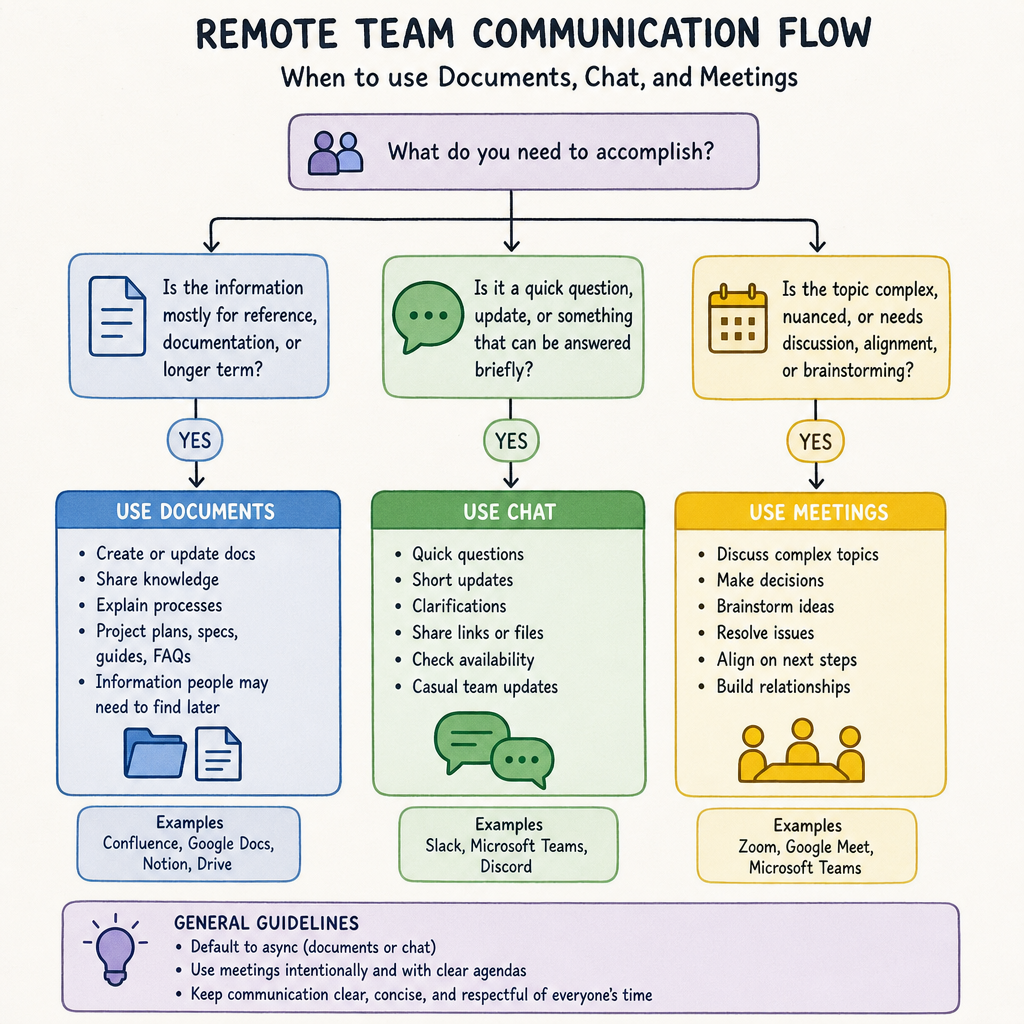
Choose communication methods according to the problem, not habit. A written update can share progress without interrupting everyone, while a sensitive disagreement may need a private conversation. The goal is not to eliminate meetings; it is to give each exchange a clear purpose.
Make asynchronous work understandable
Useful asynchronous messages include context, the requested action, an owner, and a deadline. For example: “Please review the proposed onboarding checklist by Thursday afternoon in your time zone. Comment on missing steps; I will consolidate feedback on Friday.” That message lets colleagues act without a follow-up conversation.
Record decisions where the whole team can find them. Include the outcome and enough reasoning to help someone who was absent understand the choice. Otherwise, remote work can become a search through private chats.
Give meetings a defined job
Use live time for discussion, uncertainty, relationship-building, or decisions that benefit from immediate exchange. Share preparation material beforehand and capture actions afterward. When participants span time zones, rotate inconvenient slots where possible rather than repeatedly burdening the same people.
Choose online collaboration tools with clear roles
Online collaboration tools need shared operating rules to be useful. If tasks live in several places and decisions disappear into chat, adding another platform may create more confusion. Map the team’s needs before choosing or changing its setup.
Give each tool category a distinct purpose:
- Shared documents: Maintain plans, policies, decision records, and reusable knowledge.
- Task tracking: Show ownership, deadlines, dependencies, and current status.
- Messaging: Handle short questions and coordination that do not require a meeting.
- Video or audio: Support complex discussions, coaching, and personal connection.
For each category, identify the authoritative location for information. A project update can link to the task board rather than duplicate it across several channels.
Make access part of onboarding, explain notification settings, and establish appropriate permissions for sensitive information. Review the setup with employees who use it daily. Their friction points—missing access, unclear folders, duplicate updates—provide concrete starting points for improvement.
Make flexibility compatible with accountability
A flexible work environment gives people reasonable control over how they organize their day while preserving necessary coordination. Flexibility should not mean guessing when colleagues are available or quietly extending work into every evening. Define the constraints first, then leave room within them.
Discuss which responsibilities require coverage, which deadlines are fixed, and which tasks can happen independently. Managers and employees can then agree on schedules that fit the role rather than relying on unspoken preferences.
Remote work benefits should also be discussed realistically. Working remotely may remove a commute or make focused work easier, but home circumstances differ. Offer support without assuming everyone has a private office or wants the same routine.
Practical work from home tips include protecting focus periods, taking breaks, setting an end-of-day routine, and communicating availability. Present these as options employees can adapt, not as substitutes for manageable workloads. If work consistently exceeds available time, revisit priorities rather than asking people to become better at coping.
Build connection into the employee experience
Remote team building works best when it creates genuine opportunities to know and support colleagues. Optional social activities can play a part, but they should not carry the entire burden of connection. People also build relationships through helpful feedback, shared problem-solving, and reliable everyday interactions.
Start with a deliberate welcome
Give new employees a clear first-week plan, a named contact for questions, and introductions connected to their role. Explain informal practices as well as official processes: how to request feedback, flag a blocker, or find the right decision-maker. Schedule follow-up conversations after the initial welcome, when practical questions begin to emerge.
Offer several ways to participate
Combine occasional social sessions with peer learning, mentoring, and collaborative work. Keep activities accessible across schedules and avoid making personal disclosure or after-hours attendance a condition of belonging. Ask employees what they find worthwhile, and retire activities that feel obligatory.
Recognition should be equally intentional. Describe the contribution and its impact, including less visible work such as documentation, mentoring, and removing blockers. Check how individuals prefer to receive praise instead of assuming public recognition suits everyone.
How can you assess remote employee engagement?
Assess remote employee engagement by combining employee feedback with evidence about how work gets done, then looking for patterns over time. No single survey score, meeting attendance figure, or message count can explain whether people feel supported and involved. Use the findings to guide conversations and specific improvements rather than to label individuals.
A simple review can examine:
- Clarity: Do employees understand priorities and decision ownership?
- Connection: Do they have someone to approach for help?
- Voice: Can they disagree, suggest improvements, and report problems safely?
- Sustainability: Are workload, meetings, and availability expectations manageable?
- Growth: Do development opportunities reach people regardless of location?
Pair short check-ins with regular one-to-one conversations. Explain how feedback will be used, protect confidentiality where promised, and avoid collecting information you have no plan to act on. If a survey identifies meeting overload, for example, review recurring meetings and report what changed.
Closing that feedback loop makes participation meaningful. Employees should be able to see which concerns led to action, which need more investigation, and which cannot currently be resolved.
Start with the friction employees already experience rather than launching a broad culture initiative. Ask where work stalls, where expectations differ, and where people feel disconnected. Choose a small number of changes that address those problems directly.
Use this sequence to move from discussion to practice:
- Identify the issue: Describe a specific problem, such as decisions being scattered across private messages.
- Agree on a behavior: Choose one shared decision log and define who updates it.
- Assign ownership: Name someone to introduce the change and gather feedback.
- Review the result: Check whether information is easier to find and adjust the approach.
A thriving remote work culture is maintained through consistent choices, not a finished policy document. Keep the practices that help people contribute, change those that create unnecessary friction, and make managers accountable for living the same expectations they set for everyone else.
Author

