




Pound to Dollar: Expert Guide to Conversion
Understanding the Pound to Dollar Exchange Rate
Make your next currency conversion easier to evaluate before you commit. This page helps you read a pound to dollar quote, calculate an illustrative conversion, and compare the amount you would actually receive after costs. Whether you are budgeting for travel, paying an overseas invoice, or sending money to family, start with the direction of the exchange and finish with a clear comparison.
Your next step: request comparable quotes for the same amount and check the final payout before paying.
What does the pound to dollar exchange rate mean?
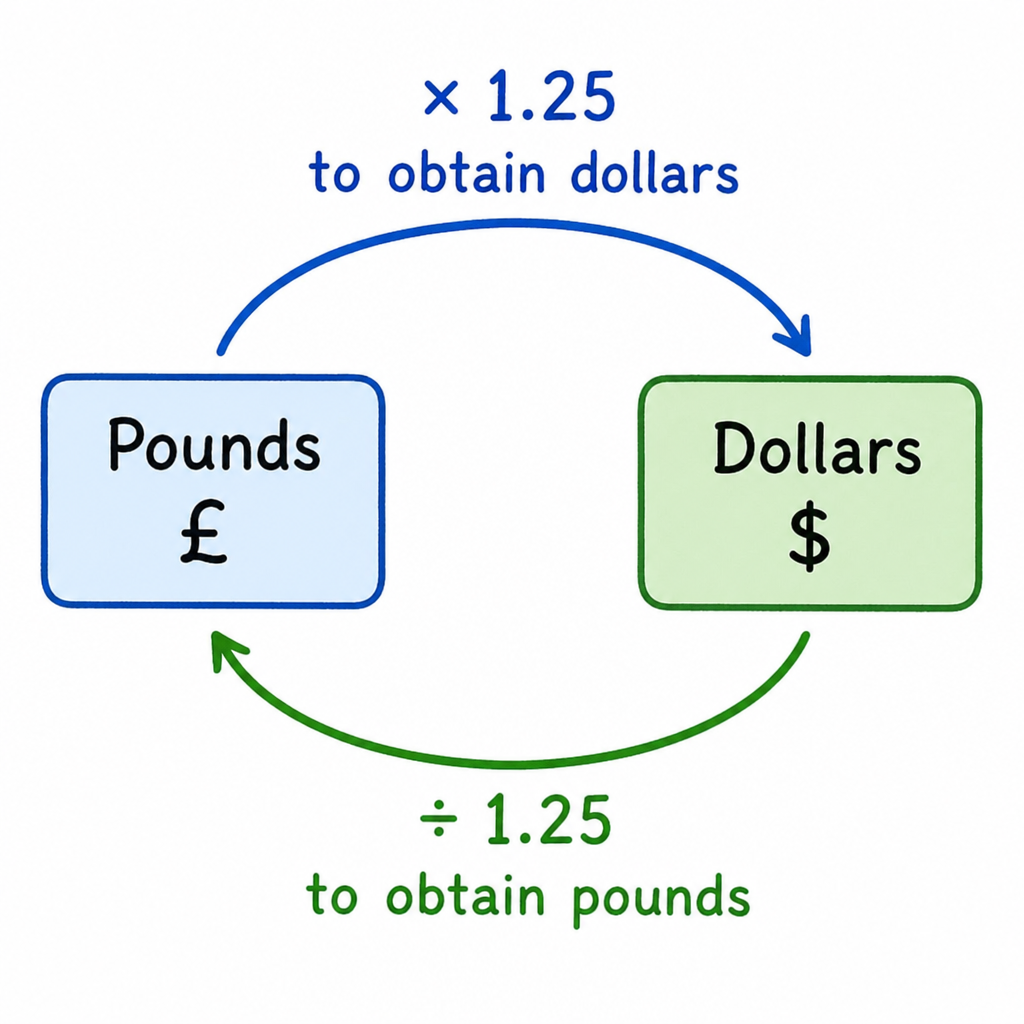
The pound to dollar exchange rate tells you how many US dollars one British pound can buy. For example, an illustrative GBP to USD rate of 1.25 means £1 equals $1.25 before any conversion costs. An exchange rate is the price of one currency expressed in another currency. (gov.uk)
Direction matters. Converting pounds into dollars is not the same calculation as converting dollars into pounds. At that illustrative rate, $1 equals £0.80, not £1.25.
If you arrived here searching for “dollar to gbp pound” or “america dollar to pound,” begin with dollars as your starting amount. Write the starting and receiving currencies beside your figures before calculating; this simple check helps prevent reversing the conversion.
Calculate your conversion in either direction
Use the following worked examples to understand the arithmetic. Every figure below uses an illustrative rate of £1 = $1.25, not a current market quote or an available offer. Fees are excluded so you can see the calculation clearly.
|
Your starting amount |
Calculation |
Illustrative result before fees |
|---|---|---|
|
£100 |
£100 × 1.25 |
$125 |
|
£1,000 |
£1,000 × 1.25 |
$1,250 |
|
$100 |
$100 ÷ 1.25 |
£80 |
|
$1,000 |
$1,000 ÷ 1.25 |
£800 |
For a pound to dollar conversion, multiply pounds by the quoted dollars-per-pound rate. To reverse that same quote, divide dollars by it. Use your provider’s applicable rate when checking an actual transaction, then account for the charges shown in the quote. (gov.uk)
Compare the payout, not just the headline rate
A promising exchange rate is only part of the picture. Currency conversion costs can include a difference between the provider’s rate and a wholesale rate, alongside transfer fees and applicable taxes. That means an offer with no separate transfer fee can still carry a conversion cost. (consumerfinance.gov)
Before choosing a quote, compare these details together:
- Total amount you pay: Keep your overall spending amount consistent across quotes, including charges added at checkout.
- Exchange rate applied: Check the rate used for your transaction rather than relying on an advertised example.
- Expected recipient amount: Look for the receiving currency and the amount expected to arrive.
- Other deductions: Check whether receiving-bank fees or foreign taxes could reduce that amount.
- Availability date: Compare when the recipient is expected to have access to the money. (consumerfinance.gov)
Consider two hypothetical quotes for the same £1,000 total budget. Quote A delivers $1,240 after its stated costs; Quote B delivers $1,225. Quote A provides $15 more in this example, regardless of which advertises the smaller standalone fee. Treat the recipient amount as your comparison point, then check whether each quote meets your deadline.
Understand movement without chasing predictions
The pound’s exchange rate is determined by supply and demand, rather than being set directly by the Bank of England. Interest rates and perceptions of economic stability can influence demand for pounds. A stronger pound buys more dollars; a weaker pound buys fewer. (bankofengland.co.uk)
For your own planning, translate possible changes into amounts rather than treating a headline as a decision. At hypothetical rates of 1.25 and 1.20, £2,000 converts to $2,500 and $2,400 respectively, before costs. That $100 difference gives you a concrete budget scenario to assess, not a forecast to rely on.
Match your comparison to the payment
Start with the outcome you need, not the most eye-catching number. A traveler planning a spending budget has a different comparison task from someone settling a fixed invoice. Use one of these starting points:
- Travel budget: Set the amount you can spend in your home currency, then compare the foreign-currency amount available within that budget.
- Fixed overseas invoice: Start with the amount the recipient must receive and request quotes showing your total cost to deliver it.
- Family support: Agree on the intended receiving amount, then check the expected payout and any potential deductions.
Keep the purpose and deadline beside your comparison. Ask the provider to clarify any estimate or charge you cannot reconcile before authorizing payment. The CFPB’s consumer guidance identifies total cost, exchange rate, expected delivery amount, and availability as important transfer information. (consumerfinance.gov)
Keep forex trading separate from everyday conversion
Exchanging money for a payment is different from taking a leveraged position to speculate on exchange-rate movements. Retail forex trading can amplify losses as well as gains, and losses can exceed the initial deposit. Understanding GBP to USD arithmetic does not remove those risks. (cftc.gov)
If your goal is simply to fund a trip or pay someone abroad, keep your comparison focused on that payment. You do not need a trading strategy to compare conversion quotes.
Take the next step with a clear quote
Write down your starting currency, receiving currency, amount, and deadline. Request quotes using those same details, then compare total cost and expected payout side by side. Keep a copy of the quote you choose for your records.
Request a currency conversion quote from your chosen provider and review the final recipient amount before you confirm.
Authors


