



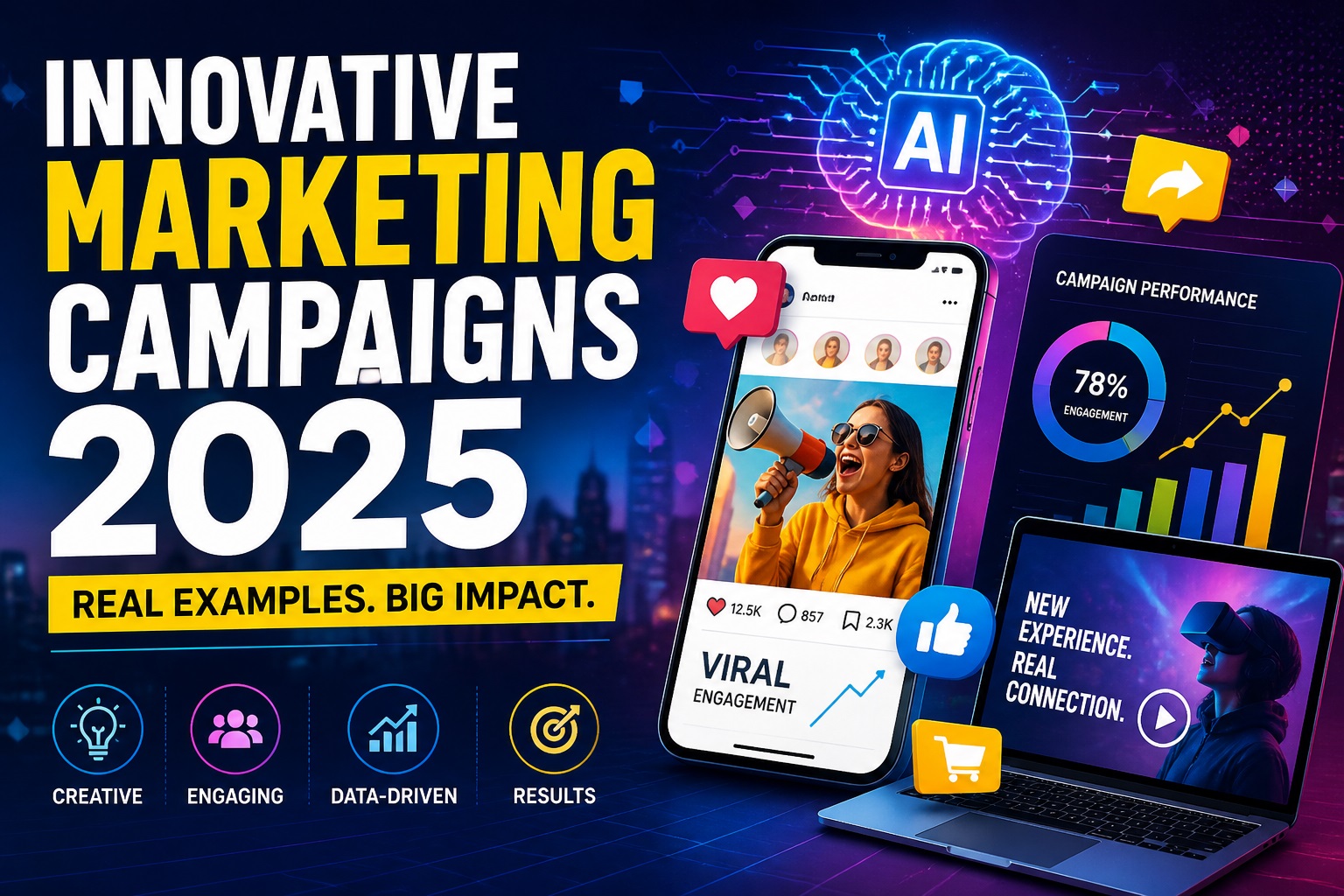
Innovative Marketing Campaigns 2025: Real Examples That Redefined Brand Strategy
Marketing in 2025 doesn’t feel like marketing anymore.
That might sound dramatic, but spend five minutes scrolling through ads today and you’ll understand what I mean. Most of it just disappears. No reaction. No memory. Nothing.
People don’t hate ads—they just don’t notice them anymore.
And that’s the real problem brands are fighting now.
So what changed?
Somewhere between AI tools, social media overload, and shrinking attention spans, marketing stopped being about “promotion” and became more about creating moments people actually care about.
And honestly, only a few brands figured that out.
This article breaks down real innovative marketing campaigns from 2025—not theory, not textbook stuff—but the kind of campaigns people actually talked about, shared, and argued over online.
What Are Innovative Marketing Campaigns?
Let’s keep this simple.
Innovative marketing campaigns are not just “creative ads.”
They are campaigns that feel like something else entirely:
- A story you didn’t expect to see
- A piece of content you actually watch till the end
- Something you send to a friend without thinking
They mix technology, emotion, timing, and sometimes even randomness.
And here’s the truth most marketers don’t say out loud:
If it feels like marketing, it usually fails.
If it feels like content, it spreads.
That difference is everything in 2025.
Why Marketing Innovation Became Non-Negotiable
There was a time when good targeting and decent creatives were enough.
That time is gone.
Now users:
- Scroll in under 1 second
- Skip anything that looks “salesy”
- And instantly recognize polished ads
So brands had two choices:
- Get ignored
- Or become interesting
And “interesting” is much harder than it sounds.
The campaigns that worked in 2025 didn’t just sell—they interrupted behavior.
Sometimes gently. Sometimes loudly. But always intentionally.
Best Innovative Marketing Campaigns of 2025 (Real Examples)
Let’s talk about what actually stood out this year.
Not every campaign went viral. Not every idea worked. But a few of them genuinely shifted how people think about marketing.
1. AI Storytelling Campaigns That Felt Weirdly Personal
This one caught a lot of people off guard.
Brands started using AI not just to generate ads—but to build personal stories around users.
Imagine this:
You enter your name or a memory… and suddenly you’re watching a short cinematic story where you are the main character.
It sounds simple, but the reaction was surprising.
People didn’t say “cool ad.”
They said things like:
“Wait… this feels like it’s about me.”
And that’s dangerous—in a good way.
Because once something feels personal, people don’t scroll past it.
Why it worked:
- It felt personal without effort
- It triggered emotional curiosity
- People shared it just to show others
Lesson:
AI isn’t impressive by itself anymore. But when it makes something feel personal, it becomes powerful.
2. Hyper-Personalized Campaigns That Went a Little Too Far (In a Good Way)
Personalization is not new. But 2025 took it further than most people expected.
Brands started turning user data into:
- Visual stories
- Personality breakdowns
- Shareable identity content
One campaign turned user behavior into a “digital personality card.”
And people posted it everywhere.
Not because they were told to.
But because it felt like a mirror.
Why it worked:
- People love seeing themselves reflected back
- It created instant curiosity
- It felt like a “digital identity reveal”
Lesson:
If your campaign describes the user better than they can describe themselves, it wins.
3. Real-World Marketing Stunts That Didn’t Feel Like Ads
This trend surprised a lot of marketers.
After years of digital-only strategies, brands went back outside.
But not in a boring billboard way.
They created moments:
- Pop-up installations that appeared overnight
- Interactive public experiences
- Small “you had to be there” events
And the funny part?
People did the marketing for them.
Videos, reactions, arguments—all user-generated.
Why it worked:
- It felt unexpected
- It created real reactions
- It naturally turned into social content
Lesson:
If people don’t film it, it probably didn’t work.
4. Creator-Led Campaigns That Finally Stopped Feeling Like Ads
There’s a clear shift happening.
Brands are slowly learning they can’t control creators like traditional ads.
And when they stopped trying to, things improved.
In 2025, creators were given:
- Freedom to speak in their own tone
- Space to interpret the brand
- Control over storytelling
And suddenly, campaigns didn’t feel scripted anymore.
They felt real.
Why it worked:
- Audiences trust creators more than brands
- Content didn’t feel forced
- Stories felt natural
Lesson:
Control kills authenticity. Collaboration builds it.
5. Gamified Campaigns That Made People Stay Longer Than Expected
This one is simple but effective.
Instead of showing ads, brands made users participate.
Mini-games. Challenges. Interactive journeys.
And the surprising part?
People stayed.
Not for seconds—for minutes.
Why it worked:
- Users felt involved
- It triggered curiosity loops
- It turned passive viewers into active participants
Lesson:
If people interact with your campaign, they remember it.
6. Immersive AR/VR Campaigns That Felt Like Entertainment
Some campaigns didn’t even feel like marketing anymore.
They felt like experiences you’d download just for fun.
Users could:
- Try products virtually
- Explore branded environments
- Interact with digital worlds
And for once, people didn’t say “this is an ad.”
They said:
“That was actually fun.”
Why it worked:
- It didn’t interrupt—it engaged
- It felt like entertainment
- It created strong memory retention
Lesson:
If your marketing feels like entertainment, you’ve already won half the battle.
7. Purpose Campaigns That Finally Felt Real (Not Forced)
Let’s be honest—people are tired of fake purpose-driven marketing.
We’ve all seen brands try too hard.
But 2025 had a few exceptions.
The difference?
These campaigns didn’t just talk. They showed.
- Real actions
- Real impact
- Real communities involved
And people noticed.
Why it worked:
- It didn’t feel performative
- It built trust slowly
- It aligned action with message
Lesson:
If you say you care, prove it. Don’t just say it louder.
What All These Campaigns Have in Common
When you step back, the pattern becomes obvious.
The best campaigns in 2025 didn’t rely on:
- Bigger budgets
- Perfect visuals
- Or aggressive ads
They relied on something simpler:
Human reaction.
Whether it was curiosity, surprise, emotion, or participation—something had to be felt.
Because without feeling, there is no sharing.
The Real Shift in Marketing (Nobody Talks About This Enough)
Here’s what actually changed:
Marketing stopped being about persuasion.
And became about interruption of attention.
Not in a negative way—but in a “pause and look at this” way.
The brands that won didn’t shout louder.
They created something worth stopping for.
Final Thought
If there’s one thing 2025 made clear, it’s this:
You can’t force attention anymore.
You earn it.
And the brands that understand that—quietly, without overthinking it—are the ones people actually remember.
Not because they advertised more.
But because they made people feel something in a world where most content feels like nothing.
Author

